
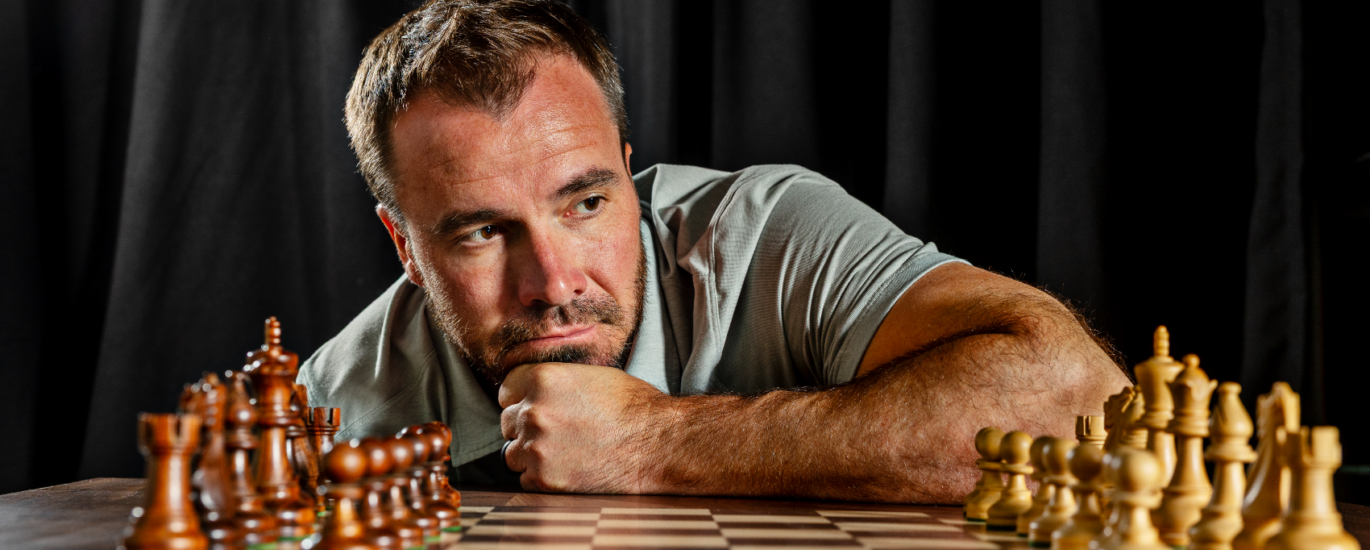
“the system of patriarchy was bad for everybody”
Amy is joined by Danny Rensch, author of Dark Squares: How Chess Saved My Life, for a courageous reckoning with his life lived under the oppressive patriarchy of a cult, plus learning forgiveness, his path to healing, and how chess helped him become the best version of himself.
Our Guest
Danny Rensch
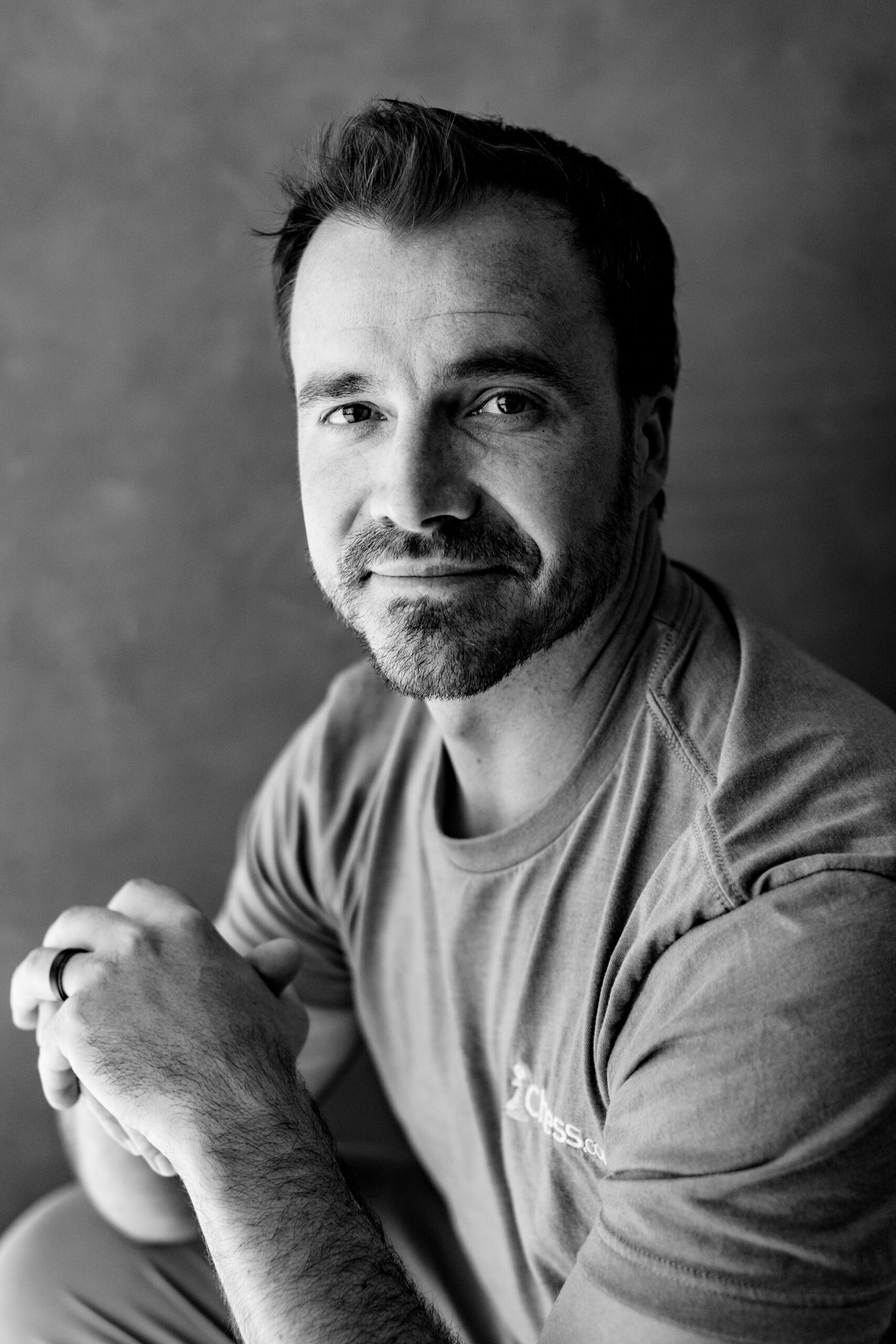
Danny Rensch is an American International Master, world-class commentator, tournament organizer, co-founder and Chief Chess Officer of Chess.com, and a chess celebrity. As a scholastic player, Rensch won multiple national championships and still holds the record for the youngest chess master in the state of Arizona. As an adult, he has become the face of Chess.com and is the author of Dark Squares: How Chess Saved My Life.
The Discussion
Amy Allebest: Here on Breaking Down Patriarchy, we have discussed many, many books, most of them non-fiction history texts or philosophical works that illuminate how patriarchy functions. We’ve also covered some classic works of fiction, like The Yellow Wallpaper and The Awakening, that highlight gender dynamics in women’s lives. And we’ve discussed a few memoirs from inspiring leaders, though not very many. So, listeners might be surprised to hear that the book we’re discussing today is a memoir by a man and set in the world of chess. But let me tell you, this book is a fascinating look at patriarchal dynamics, in addition to being one of the best page-turners I have read in years. The book is Dark Squares: How Chess Saved My Life, and the author is Danny Rensch, who is joining me in person today. Hi, Danny!
Danny Rensch: Hi! Thank you so much for having me.
AA: I’m so excited to have you here. This is going to be such a great conversation. Danny Rensch is an American International Master, world-class commentator, tournament organizer, co-founder and Chief Chess Officer of Chess.com, and a chess celebrity. As a scholastic player, Rensch won multiple national championships and still holds the record for the youngest chess master in the state of Arizona. As an adult, he has essentially become the face of Chess.com. And I will also add that Danny is on a very short list of best men that I have ever known, you’re like a brother to me and Erik, and we really, really love you and I’m so excited to talk about your book and I’m so proud of you for this book.
DR: Thank you. I don’t know where to start or follow up, but I’m so grateful to be here. I have talked about wanting to be on your podcast for a long time, and I don’t know if I can just share that we almost started this conversation when I was at the start of my book. And it didn’t quite happen, because at the time, I sort of realized in the middle of the podcast like, “Wait, I’m writing a book about this and I need to wait until we can really dive in so that I don’t feel like I’m sort of half dipping my toe into trauma or not, or patriarchy or not, and really be able to give the full story.” So, this is the first time I’m talking about the book with anybody and I can’t think of a better person to do it with than you. You and Erik are so special to me. I’m honored to be here. I’m a little nervous, but I want to say at the top that I can’t wait to dive into things and I’m glad I have an expert to walk me through a little bit. I realized driving over here, I was like, I know the experience I lived and I know the high control, high demand, and I know you’re going to intro what the book is about and my family, I guess we’ll get into it. But sometimes I feel like I don’t even know the filters of what types of things were symptoms of patriarchy and the mechanisms that were in place for that, versus things that were more generally a cult and sort of broader systems that were in place. I can’t wait to talk about all of it and hopefully share something interesting about it.
AA: Oh, it’ll be interesting. It will. And yeah, I’ve had similar experiences of like, “Wait, what was Mormonism, what’s American culture? It seemed like women had power, but below the surface it’s part of this structure.” It’s complicated. It really is.
DR: I learned that from you. You hosted an event, and I remember that the thing I took away, well, you shared a lot of things that night and I learned a lot of things that I just didn’t understand about patriarchy and about the systems and infrastructure we live in and under and take for granted. But one of the ways you broke down the part of what you grow up around is sort of the opposite of privilege is blind. Like, the oppression is blind. You build structures around it. You described it like a road, like if a road is blocked, you just go around, you don’t always ask, “Why is the road blocked?” Especially if you’re used to it, the road has always been blocked. Or the buildings are stacked really close together because that’s just what we do and how we evolve and grow. And there are opportunities or things that happen in someone’s life that give them moments to assess things from a 30,000 foot view. And one of the things that you explained that night about patriarchal systems that are sort of taken for granted, and we don’t even realize the daily ways it affects our life, it actually helped me in some of the process of writing my book. I don’t remember if I ever told you that. Because some of the things that you review about your life in that process are the things you knew you were going to write about, the things you thought you might write about, and then the things where you go like, “I didn’t even know that this was a thing until I took the opportunity to do this and was going through the process of doing it.” And I often thought back about that conversation.
AA: Wow. I’m honored. That’s so great.
DR: That’s funny I never told you that random story. I didn’t even remember it until now.

AA: Oh, that’s so cool. Well, let’s get into it the way we always start podcast episodes, which is tell us the basics, like where you’re from, maybe set the lay of the land, and then we’ll dive into the subject of the book.
DR: Okay. So, my name is Danny. Hi. I’m from Mesa, Arizona originally, and at the time Mesa, Arizona was home to what I grew up referring to as the Family or the Collective. This was a group that was formed under the auspices of a shared spiritual belief, I wouldn’t call it a religion, but at the core of it, the foundation of it was that there was a trance medium named Trina Kamp. She was sort of the guru or the deity, and in many ways presented as the boss. In some ways though, I would say that it was much more of a patriarchy, not a matriarchy, although it doesn’t necessarily matter. I guess I’ll be educated by you in terms of what it really was. But I will say that Trina Kamp and her husband were the founding members of the Collective, which was an extension of the Church of Immortal Consciousness. And my parents joined the Collective before I was born, so I was born in the group. I was actually born in a house at 920 East 7th Street, so shout out if you’re living there. Sorry if that’s awkward. That is my place of birth. It was one of several Collective houses on what we refer to as the Block. There were several houses in East 7th Street, but at some point the Collective relocated to Tonto Village, which is a very small suburb northeast of Payson, and that is where I was raised, basically from the age of five on.
And the Collective, at its peak, was about 300 people. And I still refer to it and will probably never stop going in and out of referring to it as the Collective as well as, I would say, correctly labeling it as a cult, with the time I’ve spent reviewing my life and assessing and being honest about what it was and what went down and, I would say most importantly, the scars and impressions that it left on people’s lives. But there were undeniable dynamics that it was a cult, a high control, high demand group with all types of things going on that were not okay. And we’re going to get into a lot of those things today. But I want to share, quickly, because I think some people might wonder why I struggle with that. And one of the things to say is that for many years growing up in the Collective, we were educated as to what cults really were. You think of things like Jonestown, you think of things like Heaven’s Gate or Waco, and we were indoctrinated to recognize the differences between a group that had an agenda, had any end game, if you will, very sad end games like mass suicide or others that had violent endings.
Whereas the one thing that definitely was different about our group is that there were no guns, there was no violent agenda, and there was no broader goal other than some of the spiritual goals and the idea that they were doing something that was special and unique, which led to a lot of very bad things. Not having a goal didn’t mean that there weren’t a lot of things that happened that weren’t okay. But I think one of the things I’d like to share right away as I’m talking about this, the first time I’ve ever done this after the book, is that it takes a long time to be honest with yourself about what you experienced and about your own experiences within that group, to even be able to actually tell yourself what it is. I think I’ve forever had a label and I don’t want to call it a cult. Because if I say that to people, you either use it too flippantly and people go, “Oh, you’re just angry.” Or they make the association, “Well, what was the Kool-Aid? What were you all drinking?” I don’t know why I wanted to say that off the top, but it was a cult that I grew up in. My parents were not founding members, but very early adopters. I was born into it, along with a lot of people in my generation. My dad was essentially the number two in the cult behind Steven Kamp, who’s the husband of Trina Kamp. And it was based on the hierarchy of Trina Kamp being the spiritual deity, and things kind of fell from there.
AA: Yeah. Really quickly, before I forget, you mentioned the word “trance medium”. Can you define that word?
DR: Yeah, so trance is something that for anyone who’s ever visited a psychic or a channeler, there are people who claim to have the ability to receive information, or in some ways be open to, whether it’s messages from past loved ones or in some ways a higher level of consciousness and divine, that people who are psychic and/or channel would say that they’re passing on messages. But the difference between channeling or being a psychic and a trance medium is that someone who goes into a trance is essentially leaving their body to allow for a spiritual being to take over and to speak through them. And there are all kinds of mediums out there, but this type of phenomena mediumship that the Trina Kamp claimed and practiced was that she was completely not present to the experience and that the spirit who spoke through her, who was Dr. Duran, who was a 15th-century doctor, was the one who was delivering the teaching and the messages. And that was, in many ways, our church. Trance happened pretty much every Sunday. There were people who would have private trances. Trina would trance for them. But, say we had a denomination that we regularly visited and had a ritual practice, it was that. Trances would happen on a community level every Sunday, and people would go, and sometimes Duran would give a sermon, other times it would be a conversation. Sometimes it was more wild and crazy than other times, sometimes it was inspiring and an interesting lesson to take away. But that was the practice of the group.

AA: So it was almost like Dr. Duran was the leader through Trina, right?
DR: Yes. Although, in many ways, and I share a lot about this in my book, and I’m glad I get to talk about it. For a while I’ve been saying, “I should talk about the book” and then I can’t talk about it. But I’m not saying that for any– I’m saying, like, we’re going to talk about it. But I talk about this in my book, which is that there are a lot of interesting lines that are crossed and/or confused when a spirit is speaking through a person, especially when that person’s behavior and that person’s general actions may not always be great and you’re trying to both separate your relationship with your faith with your sort of translation or justification with hypocrisy and cruelty. And I think a lot of people who went through this experience, without speaking for them but knowing I’ve had a lot of conversations, I think a lot of people have really struggled with their own experience of, “Was there a baby in the bathwater? Was there something good in there? If so, what was that?” And maybe sometimes you make a list of, “Well, these things were good about what we practiced, even if I fundamentally reject these cruel hypocrisies.” But maybe sometimes when you start to review it, things start to shift in the list and something you thought was good with more context and perspective, you realize, as you put it, that the buildings were really close together because we were just building on patriarchy. And sorry, I don’t know why I just love that metaphor you made. Sorry to anyone who hadn’t seen that lecture by Amy, it’s amazing.
I think I’ve done a lot of my own process with that, but I’m just directly addressing that I think that was one of the most confusing things growing up as a kid, especially because skepticism was pretty aggressively scorned. And in very manipulative ways, at times, where you sort of realize you’re questioning your own self worth, and you didn’t even know you were being tricked into doing it because you are doubting something about it. But you also, in some ways, did have experiences where the entity of Duran felt different from Trina. And she was not okay. She was a person that had many good attributes to her, but there were a lot of bad things, too. And I think that translating that and coming to terms with that experience is probably something I will be doing for the rest of my life. And I don’t pretend to have any of that figured out, but it’s definitely part of something that I share totally openly, but I share my best perspective about it in the book.
AA: Yeah. Well, you’re in good company. Especially among the listenership of this podcast, a lot of people are coming from high demand religions, so this will be something that very many people can relate to, parsing that out and for the rest of your life going, “What was the baby and what was the bathwater, and what was really me and what was indoctrination?” It’s hard. It’s hard and it’s good to have people to be able to be on that journey with. So to start us off a little bit deeper, since we’re highlighting the patriarchy in the book, and by the way, for listeners, the book isn’t about patriarchy at all. The book is about your life experience growing up and the Collective and chess, but there were so many gendered themes in there, like you said, and we’ve been talking about this for years. So, let’s talk specifically about the dynamics between your parents and then your dad and Marlow, who is his wife after your mom. Because I think that can be a way to start exploring some of the gender dynamics that you witnessed growing up.
DR: Yeah, so my parents were Steve and Debbie. Those are their names. And like I said, they were early members of the Collective, and I’ll spare their life story, but just to say that they came to the Collective married. But one of the dynamics and sort of teachings or theories about this particular spiritual belief or group was that everybody has what was called a “like vibration”. We’re going to call it a soulmate, just to make it quick in terms of people’s understanding of it. But the idea is that there’s someone you are on the same vibration on every level, and together you are moving toward God, moving toward your highest self, moving toward your highest purpose. Which, in many ways, can be thought of as not a bad thing, to think you have a soulmate and to have a partner to work things through. And if done appropriately, someone to reflect with and help you grow in all the ways that we all work hard to make our marriages work, right? So, you can get it.

But through the larger dynamic, which was that if you weren’t with your like vibration, if you weren’t with the right person, that you couldn’t reach God, that you’re sort of out of the kingdom of heaven. And that even more thoroughly, people, men and women were both evaluated as to whether they were providing enough value to be in a like vibration relationship. But specifically women were put into the lane of– because it was projected and sort of presented as a feminine-based teaching, which was a term used a lot, partly because Trina Kamp was the “leader” and she was a woman, but whatever other reasons for that and I can get into what I understand to be the best history of it, women were held to the standard of being the spiritual voice to God. So this is different, I think, from a lot of mainstream religions in that if there are men who have a relationship with God or they can hear from God, women were supposed to be the connection to and the direct way for a man to experience God and to lead their marriage to enlightenment, if you will. And while growing up, that actually helped us think that we were special and different, because a lot of male dominance and patriarchy in other religions was actually pointed out to us. And we actually saw what we thought were bad things about a lot of other religions because we were a feminine-based teaching and the spiritual voice came from the woman in the marriage.
But in reality, what this actually meant in practice was that women were held to almost impossible standards in terms of the expectations to keep the marriage together, and the men were given sort of free reign to believe that if the woman wasn’t up to snuff, it was time to go shopping. So, what happened in the relationship with my mom and dad was that after a few years, whatever cracks they may have already had in their marriage, because every one of them has them, I think I joke, so I’ll say the line I said in the book, that in many ways people came to the Collective under the idea that it was going to save their marriage, when in reality it was a fast track to a divorce. And I think that was true for what I observed a lot, and certainly it was true for my parents. Before I was born, my dad had already slept with other women in the Collective under this sort of justification of being on a spiritual journey of whether other women were his like vibration. And their marriage was basically completely falling apart because my mom was not up to snuff and she was being judged and processed, and we’ll get into the term “processed” here because that was the group dynamic of what people did when they got together and talked at a meeting, and she was being processed and labeled as not being good enough for my dad.
So my dad simultaneously demanded that my mom get pregnant, which, again, their stories were always weird. I think once I was born my mom was like, “No, I loved you. I always wanted a kid and I was worried I had waited too long.” And I think my mom’s version was true, she was like, “Yeah, your dad was the trigger because of his dominance and because he was forcing this, but the only reason I was so scared is because I thought I was already too old.” She didn’t have me until she was 37, which was much older than a lot of people in the Collective. Whatever the truth is, I was born and it didn’t matter because six weeks later my dad left my mom to marry the oldest daughter of Steven and Trina Kamp, who at the time was 19 years old, and her name was Marlow. My dad was 38. And so to put a spotlight on that dynamic, you have a system where the men are under the auspices of it being a feminine-based teaching to find their spiritual voice, and “spiritual voice” was actually a term used to find their spiritual voice. So even though the women were the spiritual voice, the system allowed men to have free reign. Women, even if they had kids, were left behind. There were many men who followed suit of my father. He wasn’t the only one who did this. My dad was one of the only ones who married a much younger woman, who also happened to be the oldest daughter of Steven and Trina Kamp, which with time has become more and more clear as something that was presented as this massive spiritual moment and movement for my dad. I would learn later that in many ways Trina Kamp actually forced my dad to be with Marlow because she was drunk one night in a process. And that’s actually not in my book, but I’m sharing it here for the first time. So you sort of got the reality that it was, in my view, and again, always correct me if I’m wrong throughout this process, if I label something a patriarchy or not, but it was like a patriarchy posing as a matriarchy.
AA: Mm-hmm.
DR: It had a lot of levers or boxes that would allow you to check that the women were being put in a different spot or on a non-traditional pedestal. But in reality, the men were essentially allowed to act, in many ways, cruelly and without accountability to make their marriage work. Because there was always an out card that, “Ah, you’re just not my like vibration. You’re not good enough for me spiritually. I need to find someone else.” And that’s kind of the PG version of what I just laid out, you know? But that was the quickest way to describe what I was born into. So I’ll wrap a very quick ribbon on it, because I think I touch on it here. Then when I was born, because my mom was sort of scarlet lettered and pushed aside in many ways, way down the totem pole, because that was a phrase that we use in the Collective. They would literally have people describe, “Where do you think you rank on the totem pole?” And they would have people rank in open groups with others and there would be fights about this stuff. The idea of calling out unspoken competition and jealousies and things that exist in humans became an all-out free-for-all of violent expression, and it wasn’t good. But my mom ended up getting sick and my dad was gone, so I ended up being passed around to a lot of different women as a baby. I had different wet nurses, and two of the women ended up being women that also had babies by my dad, one of them being Marlow, and then one of them being another woman that my dad was with. So that kind of frames a little bit of how I came into a bit of a wild situation. Sorry.
women were held to almost impossible standards in terms of the expectations…and the men were given sort of free reign to believe that if the woman wasn’t up to snuff, it was time to go shopping
AA: No, it’s good.
DR: I’ve got my pillow to hold onto, so everything’s gonna be okay. When reality hits, if you need a pillow, let me know.
AA: I might need a pillow. I remember you telling us that story on a run one time. You were talking about being nursed and just the fact that all of them were lactating because your dad had impregnated all of them around the same time, and just the trauma of that.
DR: Yep.
AA: Whew. That’s heavy Danny.
DR: And there was a lot of promiscuity. I mean, there was also promiscuity by the women, but it was mostly the men. I think everyone was playing the game of finding the right spiritual mate and justifying things that were not really okay nor setting up a good example. Which was ironic because there also was a teaching that projected and believed that the sins of the parents are cast upon the children, and that patterns persist in families and that any action you do, you know, you will reap what you sow in this lifetime or the next, which is a pretty high calling to commit to. And I don’t think it’s the worst thing to hold yourself to being the best person you can, but when you’re doing that and then acting this way, a lot of times the lack of self-reflection on what they were bringing their kids into sometimes blows my mind to think about.
AA: I do have to say, I want to point out because you said that in terms of labeling things, patriarchies and matriarchies, and we’ve talked about this before, there are so many examples of patriarchies kind of masquerading as women-centered or maybe even using the word “matriarchy”. I can think of lots of religions that are that way, and even people will say that there are so many matriarchies, like, think of Queen Elizabeth in England. And it’s ridiculous if you look at it even just one level under. She happened to be a woman leader of a country despite the fact that she was a woman, not because she was a woman. Structurally, completely a patriarchy, but with a female figurehead. And sometimes that does lead, as you said, people to be able to kind of erroneously point to something and give an excuse.
DR: It’s a facade.
AA: Totally.
DR: There was a lot of that, too. I mean, Steven Kamp and Steve Rensch, my father, were the leaders of the Collective. And the power dynamics ran through them on every possible operational level. You wouldn’t even be able to say that Trina Kamp was the CEO and they were like co-COOs. It was like Kamp was the CEO, my dad was the COO, and there was this chairman of the board presented as the face of the Collective. Steven Kamp often pointed to that, which is that because it was a feminine-based teaching and that he was supporting his wife’s purpose, because it was his wife’s purpose that brought the Collective together, which was to trance and to bring Duran’s teaching to the world. Almost as if that was a bit of a get-out-of-jail-free card, that other men who wanted to ever challenge his dominance or in some ways his patriarchy, he was always able to play both ends kind of against her. That was something that you learn over time and you can see it more clearly, but when you’re used to it, you’re like, “Well, that’s how it is. I want to be with a wife who has her purpose, because I want to be the most spiritual being possible like him.”
So the pressure was all around because there was also a very traditional looking dynamic because a lot of the women didn’t have jobs because they were uneducated, pulled out of school, told to get pregnant or given service industry jobs. So as far as examples where patriarchy hurts both men and women, there were expectations to be a breadwinner and a performer in a way that men weren’t as encouraged to pursue things, like if they wanted to pursue something that was a little bit less traditional in terms of being immediately revenue-driving. Because the expectation was that women are homemakers, a lot of them uneducated, a lot of them started having babies very young. And you have to provide in this way, but also you’ll never be as good as Steven Kamp because “you all go out and make money, and my wife is the one who makes the money, so I’ve actually got it all figured out.” It was an impossible dynamic. Does that make sense?
And I would say that, and again, correct me if I’m ever wrong about the dynamics of patriarchy, matriarchy, or the system, but I’ve looked at it as the system was just unfair all around. I would actually say, and even though it wasn’t my lived experience, because I was not born a woman and I did not grow up a young woman in the Collective, I would say objectively that young women in the Collective had it harder than young men. Full stop. Even if my unique experience was kind of a wild one, as is chronicled, and I definitely went through some wild sh*t, but I think young women had it harder. I think they were set up in more ways that, in my opinion, just feel like it was impossible to overcome so many things that were going on. But I can see very clearly how the system of patriarchy was bad for everybody.

AA: Yep.
DR: Because no one could really win, fully. Especially when at the middle was this impossible thing to compare yourself to, which was that the woman’s purpose was leading the Collective, and the guy who’s number one will always be more enlightened because her purpose comes first, even though he’s really kind of running a business through the figurehead of his wife. Does that make sense?
AA: So interesting. Yes, yes. Tell me a little bit more about how most of the women, I guess, some of them were joining the Collective like in your parents’ generation and then some were being brought up in it in your generation. Tell me a little bit more about that lack of education and what a girl and woman’s life path was going to be in the Collective.
DR: Yeah. As I jump into that, I’ll say there was also an interesting middle generation, which was children who were moved somewhere between the ages of five to early teens. Because there were people moving to the Collective who had kids. And I only say that because the detail that I think is interesting in terms of how people acted, how some of them rebelled earlier than others and left, whether in the night or otherwise, and felt like they needed to escape. But in regards to young women specifically, there weren’t really high expectations, which by itself is its own disadvantage on education. Because I think some women were the exception to the rule, which doesn’t mean that it wasn’t true that some were encouraged to go to school based on, for whatever reason they were recognized as being smarter. I don’t know all the dynamics of everyone’s family. Maybe it was that some mothers and fathers fought harder, but overall the norm and the expectation was to be a homemaker and to start a family young. And to, if anything, have a job in the service industry that helps contribute to household bills, which was generally– the Collective was a hundred percent financially merged community or commune.
So when you already have that dynamic as far as what people see, and we’ve talked so much about representation based on the examples, it’s justified and promoted as the right way, but even if you don’t necessarily like it, it’s all you know anyway. When in reality, a lot of it was just… and I’m not even saying this disparagingly, because everyone comes from their own background, but Trina didn’t come from an educated background. She was pulled out of school early and she would say she was a cowgirl and her sisters were not necessarily following that path. So because the deity was like that, everyone else should be like that, because that makes you the most spiritual. And Trina also started having kids young.
So what I’m saying is that in some ways, I look at it now and see a very clear path of the sins of the parents were being cast upon the children, it’s just that the parents with the sins didn’t realize they were the problem and that they were creating this infrastructure so that the young women didn’t have any other examples. So now they’re on an uneducated, starved for opportunities path and then being told very, very, very young that their value, their self worth will be in a like vibration relationship, which is not just to bring the man to God, but to have babies and build a family. And you know how that played out. Probably in its most extreme, I would say, maybe one of the biggest blunders the Collective made in terms of practices that have a good idea, if you had a great soulmate who could help you work through your stuff and ultimately be a partner in you becoming the best version of a human being, but then telling 9 and 10 year-olds who their life vibration is, betroth them, and then when they’re in their very early teen years, pressuring them to have sex and or scorning them if they don’t like their mate sexually, it was a serious problem.
And this is probably one of the only– well, no, it’s not. There are a lot of things I did not bring into my book for a couple reasons. I think the most important one being that I made the commitment that this wasn’t a cult exposé. Not because there didn’t deserve to be an exposé or stories told, but because that wasn’t my reason for writing the book. I wanted to share a story, and my story, hopefully through some uplifting tales, but also not denying the struggle and the f*cked up sh*t that happened. But then secondly, regardless of it not being a broad cult exposé, I wasn’t there to tell stories that weren’t my own. And I hoped that if I opened whatever door I could and provided a bit of a framework, I’ve had a lot of people, the relationships I have maintained from the Collective, who’ve had a little bit of chance to read it, they’re like, “Oh my God, I’m so excited that your book can serve as like the first thing where I say, ‘Just read Danny’s book and then I’ll tell you my story.’” So they’re like, “I don’t have to explain the teaching, the history, the like vibration.”
And I’m saying that because I really did hope that that would help. I think a lot of young women had stories, very much like I just told you, which was that they were betrothed through the lens of like vibration against their will. Or even if it wasn’t against their will, they were so young to be able to say. Your frontal lobe isn’t developed. How do you even know? And then pressured into the relationships. Many of them, when they weren’t going well, already had very deep self-worth issues based around the fact that, “the boy I am supposed to be with doesn’t like me and now they’re on a spiral.” And some of it was acted out in different ways with behavior and drugs, and again, I don’t want to get into everyone’s story. But then there are those who submitted, and a lot of young women have stories of feeling like they could literally feel the pressure of the Collective in the bedroom with them the first time they were having sex. That’s the level it was at. And other stories that are not mine to tell. So I think I’m just on an extreme side. That’s some of the stuff that was acted out in a way that really was not okay, and I would say worse than a lot of things that went down there.
AA: Yeah. And that whole concept of the girl or the woman being selected, like you’re saying, in service to the man. So you could see how it would be easy to confuse that, that she was the one who had the higher status because she’s being put on the pedestal. But it’s the man putting her on the pedestal, and he can yank her down from the pedestal anytime he wants. Your role is to be this person’s path to God because he needs to get to God.
DR: And directly. I mean, my wife would share many stories. There are stories in the book about our marriage, and we can get into any of those that you want, but my wife has her own long list of stories that didn’t get in the book in terms of where she was judged, processed, scorned, directly told and literally labeled for the downfall of my lack of chess performance, in many cases. And at times even by me, based on my teaching and what I do. But the self-worth and the shame, and then the stories when you have no outlet for processing that in a healthy way, I think what you said is exactly true. You were already being conditioned to believe that you were the keys to someone’s ultimate enlightenment and success without even knowing how to be the keys, not even knowing if you wanted to be the keys. The whole idea is kind of crazy, I don’t know.

AA: I do want to hear more stories about Shauna, if she’s okay with that, and if you’re okay sharing some. But first, I do want to go back to the processing. And, like you said, patriarchy harms men, and the totem pole or the hierarchy and the comparing is one classic sign of a patriarchy, where a few men at the top hold all the power, they oppress all the other men for various reasons, and all the women because they’re women. That’s just classic, that kind of sometimes violent oppression and stratification of all the people in the community. So I guess I wondered if you could talk a little bit about processing, because that seems to me to be really integral to the way the hierarchy was maintained. Is that right?
DR: It really was. And yeah, to take a step back, a process as a noun would be a group gathering of people within the Collective to express to each other, to share their thoughts and feelings.
AA: Okay. Like a therapy session, a little?
DR: Like a group therapy session without any licensed therapists, and with people who were there in many ways to later use the very information you were sharing against you. And because of awkward power dynamics, multiple relationships that had been with each other, and insert any other aspect of who was really in charge versus who was just playing the game, and then dump alcohol all over everybody. All that and then just dump alcohol on everyone. And scene. I’m sorry I’m making light of it, but it’s the first time I’m talking about it. I’m an entertainer at heart, so that’s and scene, right? So here’s the scene. That was a process. On the best of versions of nights, and I think some people would share and I would say that I experienced some processes that were not inherently all bad and that with the right group of people, you could share vulnerably and be supported and loved. And people could even give an honest take on your life and you could appreciate the feedback. And I think that the right group of friends, like, we all search for connection and truth and love. And the problem is that those were the exception that proved the rule, which was that it really wasn’t like that because of all the things that I said.
And I’ll say quickly before I describe even more specifics about the processes, because they were violent and they were very clear signs of totem pole behavior and how hierarchy was taught to kids at a very young age to then commit the same sins to each other. I will say that one of the things that I educated myself about and or became educated about, and this is actually a common theme across a lot of cults, and I didn’t know that. I mean, it’s referred to differently based on the cult and the terminology that was used. I’ve heard the term “the Game”, which was used, and The Sunshine Place is a podcast on Spotify that breaks this down if anyone wants to check that out. I’ve heard of other types of groups where, again, a similar word to “process”, and some just called it a meeting. But this idea of the members of the cult committing acts of cruelty to each other is a big part of the dynamic that keeps the group in check.
And as I saw that theme, and as I said, I became a little more educated on the fact that this was actually presented as something super special that made us different, even though they were hard at times, ultimately they brought us closer and allowed us to evolve in ways that others weren’t. In reality, what you had was that when everyone is doing the self-policing and the self-judging and the self-covert contracting, writing the unspoken expectations on each other and then monitoring whether they’re delivered, and then either openly reporting to them to the leaders of the Collective behind their back, or even just rising in their own status because they might be more articulate than others and/or able to pound their chest more effectively in a different way, you sort of check a massive box of the group controlling itself.
One of the things that I wrote about in my story that was very true for me, at least in observing our group, and I won’t speak for members of other cults, but I will say that I feel very strongly that one of the only things that kept the group together for as long as it did was the processing. Not because you enjoyed it yourself, but because as you committed sins against others and as you expressed judgments and/or were cruel and/or acted in ways that were out of line, a lot of what happens in, like, addiction behavior is that you’re not coming back because you enjoy it, you’re coming back because it’s comfortable and you don’t know any better. And ultimately, to leave the group isn’t just to come to terms with the fact that you no longer want to be abused, but that you also abused others. So when that became sort of clear to me and I saw, again, more examples of that, I think it was a bit more of an example that education really is the key to healing and solving all problems in life. Because I can acknowledge that I had my own ignorance, and these days even ignorance is a polarizing term, even though it just fundamentally means lack of educational information about something. I had my own lack of education and lack of information about a lot of other groups that probably kept me blind to the aspects of our group that were a cult and that were just straight up not okay, and that actually had been done before and that there was a system to this. And that it wasn’t as mind blowing as I thought, that I was coming to terms with this. And that is both really hard to acknowledge and also helps give you perspective.
So, yeah, I guess I would say that the process was– but then you also had your process, which was your own sort of case, your own issues, and everyone knew your process. Like, “Danny’s process right now is just getting his ego out of the way so he can win chess games” or whatever. I’m just making examples that a 12-year-old was told. And then to be processed was also a verb, like you were going in to have a meeting with your partner, your spouse, and you were being processed by the ministers. So it was a term that was used broadly to describe that entire dynamic. And there were very clear hierarchies within the process, often overseen by a minister. There were four ministers in total, which were Steven and Trina, and then Steve, my dad, and Marlow, the very young woman my dad married. There were other ministers ordained over time, but those were really the four core. Similar to what we talked about earlier, even if there was a woman dominating a process, it didn’t change any aspect of the hierarchy and the ultimate patriarchal system that was set up to consistently be compared and contrasted and frankly held you to an impossible standard. But you played the game because you were holding other people to the same standard and you found your place based on that, and it was not great.
you’re not coming back because you enjoy it, you’re coming back because it’s comfortable
AA: Yeah. Okay, so the next question, the next big theme, and you’re so brave, Danny, because I think this has to be super painful, but there’s the theme of the fathers and literally patri-archy, like the rule of the father. You’ve already touched on that, but in terms of your dad and the different father figures that you had growing up, I think there’s a quote in the book that said, or maybe it’s just kind of a concept, but that you needed to choose who your father was so that you would know who ran your life, basically, because your father kind of runs your life in the system. Can you talk about that a little bit?
DR: Yeah. I’ll say first that probably the relationship that has been the hardest for me to navigate throughout the commitment to write a memoir has been the one with my dad, and for many reasons that people will read. And what I will say is it was both for the individual relationship with my dad and the trauma and the pain that was inflicted, but also I think more broadly because of what he represented as a figure, both in some of the early paths I was put on via the actions of leaving my mother and literally putting us on a path of, you know, a mom with a scarlet letter and like the orphan bastard kid of Steve Rensch. So, I’m kind of just framing that. Thank you for saying that. This has been very hard. It is hard to talk about. With my dad in particular, we’ve done a lot of work to heal to the best level we can. But I think my dad’s obsession, to some degree, with my choice of him being a father or not, in some ways it’s kind of weird because you’re like, well, if he really is your father, shouldn’t he just know it? Why does he need you to choose it?
But there’s a larger thing to explain, which is that in the Collective, kids were told as they came into their own to ask the question of whether they thought their parents were their spiritual parents. In a similar way that everyone kind of polices each other and you create this impossible dynamic where really it’s perfect because then Steven and Trina are the only parents you can really trust, both if you are an adult or a child, and that was set up. My dad was many times challenged as to whether Steven Kamp was my real spiritual father or him. I also had a stepfather named Dennis, who remarried my mom, Debbie, for many years when I was a kid before I was taken away from my mom, which is a big part of my life, and it was framed as my dad was my dad, even though he really wasn’t my dad. And I’m giving a little bit of background, and I’m sorry for confusing anybody, but otherwise we will be here for hours, if you want to buckle up.
But what I’ll say is that my dad had two things going. One, wanting to be more important, or at least as important as Steven Kamp, because Steven Kamp was somewhat obsessed with my chess. He was always abrasive in his challenge of whether I had chosen him as my father through the spiritual lens of “Am I really your father?”And it was a way for him to claim ownership over me as his son, in some ways, you could argue, righteously so, a little bit based on his pain about how Steven Kamp had handled the dynamic and what he felt he wasn’t able to do, and he and I have talked about that. But back to the concept of the patriarchy, it in and of itself is its own indictment of the problem, which was that everybody in the Collective, to some degree, was being told what their life was supposed to be, either by Steven Kamp or Steve Rensch. So, regardless of the unique thing that he was my blood father, all the young men and a lot of men would have their own stories of their self-worth and their value being governed and run through whether Steven Kamp and Steve Rensch approved of your purpose, of your plan, of your anything.
And again, there were so many horrible dynamics that young women went through, and some young women did have that same experience of a direct sort of ordainment or non ordainment. But I think one of the things that the young men went through in terms of that exact experience was that if you were being successful, you were being approved and told that your purpose was on track. And the moment you weren’t, so many bad things were happening. Being judged, being split up in your marriage, having your kids taken away from you, or at least they encouraged it, or in some ways just the thing that you love no longer being an option, you’re not allowed to do this anymore. And choosing the teacher was a big part of that. My father was actually wrestling with this dynamic and because of the power struggle he had with Steven Kamp, who was really acting as my father, but in many ways this dynamic of the children choose the parents and the student chooses the teacher was flipped in so many ways that you had to like throw yourself and prostrate yourself at the feet of Steve and and Steve, but if they didn’t think you were being successful enough, they could rip it away from you at any time. In the same way that it’s like a feminine-based teaching, they’re the spiritual voice, but if the man isn’t bearing the fruits of that, obviously it’s a like vibration relationship, well then you’re not his like vibration.
And it took me a long time, I mean, I deal with this all the time. I will be in therapy about this probably for the rest of my life. But the relationship with my dad led to a lot of, you know, I’ve referred to it as the war with the Rensches, and I hate using the term war, but I don’t always know how else to describe it. But there was a literal time period when I was coming to terms with just how cruel this was and trying to reheal my relationship with my mother, who I was taken away from. And then 10 years later, now that I was allowed to speak to her again and working on that relationship, I couldn’t even deal with my father around the hypocrisy of how much pain and how much self-worth had been wrapped up in feeling like if I wasn’t close to Steven Kamp and Steve Rensch, I wasn’t close to God. And that perspective is a very traditional way you are set up, to experience that your church and your pastor and the priest, so if you’re not following the doctrines, then you don’t have a relationship with God, nor do you have any experience of what that is. And it was so wrapped up into the power dynamic and their own power dynamic with each other that it was very hard. And I’m sorry if I bounced around a little bit, I think it wasn’t even because I was not wanting to talk about anything, it’s just a hard thing to talk about for both personal reasons and because it’s a very difficult thing to quickly explain.

AA: Yeah, I mean, people talk about high demand religions and high control environments. Just to validate, Danny, because you know I grew up in a very high control, high demand environment myself. But you have layers there, because there was a lot that was controlled and demanded in my environment but it would never have been like “We’re going to take your piano lessons away if you don’t obey,” or take things that were fundamental or “We’ll take you away from your mother if you don’t do the right thing.” I can only imagine the anxiety that that would cause a kid.
DR: Yeah. And then there were the direct, both spoken and unspoken messages that taking away your relationship with spirit and God, the threat was that if you’re not on the right path, I mean some religions use the term you’re going to hell. But in this teaching, it was that you would have to reembody, which is a teaching that was based in the belief of reincarnation. Dogma is dogma regardless of the framing, because when it’s used to oppress and control, it’s not right. And even if there are parts of reincarnation that are very different from a single lifetime spiritual belief system, the threat of “you are not on the right spiritual path to God and it’s being reflected in your life because clearly we see the evidence here. And so the only way to shake this up is to take you from your mother here or to break up your marriage there.”
And then in addition to growing up in a very patriarchal household, and you and I have talked some about that, there’s the high demand and the high control and the stress of the patriarchy in the house. And then there’s the collective dynamic and then the broader spoken messages that it’s even more of a sin to know that you’re in the highest teaching and leave it than it is to have never known at all. And that’s a common phrase. So you had a lot of self-worth shame, so much stuff wrapped up even in the idea that you might doubt it. And I’ve said this before but I’ll say it again, because it has been my experience. What I have learned through that in all the years of working on myself and healing a traumatized brain is that you learn that abused kids don’t stop loving their abusers, they stop loving themselves, and it takes a long time to learn to re-love yourself when you believed that you were the one who was wrong to ever be skeptical. Or this bad thing happened because you were on the wrong path.
It’s a hard thing I think for people who did grow up in amazingly healthy homes, and that’s amazing, right? But if you don’t have that experience of being abused or put in that sort of dynamic, it’s hard to totally understand it at first or relate to it, because you go like, “Well then once you got older, why didn’t you just leave?” Or this and that. Similar to the self-policing dynamic, you sort of self-police your own feelings and you’re building castles and cathedrals around these different parts of your feelings to protect yourself from the truth, because that’s what an abused kid does in order to survive their environment, because it’s a lot safer to believe that you are the problem than it is to believe that the person who is providing for your health and safety and wellbeing is the problem. And when you multiply that by a broader collective and you realize it’s the same for many of the parents, it has given me compassion and forgiveness for my mother in many ways, because of things that we went through. And of course I want to talk about my relationship with my mother and how that rolled into my relationship with Shauna. But I would say that I learned that that dynamic of abused children don’t stop loving the abuser, they stop loving themselves can also apply to abused adults. Even if they look like an adult, emotionally immature people find their gurus for a reason. And I’m not saying that everyone who joined the Collective was by definition an emotionally immature, stunted person, but maybe I am saying that. That was definitely the rule, right? If you’re looking for someone to provide a path and provide the answers for you and you enter into that covert contract, and then you are abused and you develop skepticism about your faith and about your church or about your leaders, it’s a lot easier when you never dealt with the reasons you were there to begin with, or your traumas or your pain, the things that put you on this emotionally immature path. It’s a lot easier to self-police than it is to question and doubt, and that’s how the parents were able to do what they did to the kids and the kids were able to do what they did in their life. And everything survived for as long as it did because Steven and Trina were the parents. It was Never-Never Land. No one was ever growing up and the system kind of ran itself.
AA: Wow. Okay, let’s talk about your mom and Shauna. Start wherever you want. You can talk about your relationship with your mom, and then I do want to talk about what Shauna endured when she joined the Collective.
DR: Yeah. We’ve talked a lot about the dynamics of the Collective and the patriarchy that it was. And my mom, an early member of the Collective, was a part of the system and a devoted member to all the best of her abilities. What I would say, and the story that I share, is that my relationship with my mom in hindsight was always kind of set up to at some point be fractured based on how people talked about her, how I saw her as the scarlet lettered woman, how I was positioned very early on to see her place in the totem pole, you know, at the bottom or near it. And so you’re already developing your relationship with how you evaluate your mom, and then I would say that probably you develop all your early framings of women through your first relationship with the most important woman in your life, which is your mother. So, seeing a lot of that stuff was very hard, even if I didn’t know it was hard. But then as I shared in my story, as I got really good at chess as a man who also now had a purpose as ordained with chess, that was excelling very rapidly and I was becoming one of the best players in the country, I quickly became higher on the totem pole than even my own mother and even my own stepfather, who was, as you described earlier, there were the alpha males and a lot of beta males that are sort of kept within the caste system of their place on the totem pole. And at some point, my relationship with my mom and Dennis, my stepfather, completely fell apart because I was conditioned to believe that I was better than them. And they were simultaneously being conditioned to believe that if they allowed me to remain in their household, that their marriage would fall apart because I was sort of superseding them spiritually. And again, this is super f*cking wild to talk about, but I would say that the relationship with my mom has been the biggest… I haven’t talked about it yet, so I might cry a little bit. We’ll see how that happens on the podcast, but that’s okay.
AA: I’ve cried lots of times.

DR: It’s been the biggest lesson of my life. Simultaneously the biggest healing and some of the biggest regrets. So, when you’re a 12-year-old kid who tells your mother that you think you need a new spiritual parent and you mean it and you believe it and you’ve been conditioned and brainwashed to believe it, and then you don’t see your mother for 10 years and you lose that relationship. And then, with some weird bumps along the way that people will read about where we had interactions that, if anything, made it worse. And then my mother, after a few years of healing with my mother, and I’m sparing you some of the life story because it is a podcast, my mom then died very young of a massive stroke, so then I lost her very quickly. So when you work so hard to change your relationship with someone because of what you’ve been through and then you lose them very quickly, it definitely gives you a sense of perspective and gratitude. Along with the flip side of gratitude, you have to learn, you know, better make grief your best friend, because that’s how you learn how to deal with it. So, my relationship with my mother was very… It is a traumatizing relationship. And for anyone who hasn’t read the book yet, I’m sorry, but it doesn’t have a happy ending in that regard to my relationship with my mom.
And there’s a lot more to that in terms of how I learned to forgive myself. I was a kid for everything that happened. I’ve also learned to forgive her because I was also very angry that she allowed me to be taken away, that she was a participant in the broader, not just patriarchy, the broader cult, the entire system. But obviously, as I also share, there’s the fact that we had the time we did and healed to the level we did. And as I’ve educated myself and gained the perspective I do about what she was going through, I consider her the strongest person I’ve ever known, and my book is dedicated to her for a reason.
And then the best part about my wife is that, and we’ll talk about everything she went through, or whatever we can, she went through a lot more than is in my book or that I could tell, that would be my place to tell. But my wife never felt that way about my mother, which is very revealing because she had every reason to, and could have easily hopped on so many bandwagons about Debbie Sampson. What’s funny about saying the name Debbie Sampson, so, my mother was Deborah Rensch at some point, married to my father, then Debbie Gordon. But in the Collective, when you referred to a single woman in a way where you were sort of shaming them, you always referred to them by their maiden name. So when you said “Debbie Sampson”, like, “This is a Debbie Sampson energy” was like–
AA: Oh my goodness.
DR: It was a thing that meant something. It carried a charge behind it. I don’t even explain that in the book. Yeah, so Debbie Sampson. At one point, my name was also Sampson. There were multiple name changes throughout the wild process. But my wife never saw Debbie Sampson, you know, she saw Debbie Danny’s mom. And she loved my mom and always thought that it was a bit f*cked up that when she poked and prodded at my paint of my mom, because I had participated in all of this as a child and basically, if you want to call it self-taken, self-kidnapped, I had self-abducted and been taken and removed myself. It’s a very complicated thing. But my wife never saw my mom that way, and she was immediately pushing for healing up against which what was, at my worst, rage and anger and abusive behavior toward my wife because I was a very wounded person who was wounding those around me if they were brave enough to poke the bear and stick around, you know? And so as my wife was brave enough to poke the bear and stick around and we were fighting for our lives in our young marriage, she never let me get away with not having a healed relationship with my mom, which, of course, I’m now eternally grateful for. One of the other things that makes my wife very smart and strong and ahead of me in so many ways, she knew that it was the right thing to do, not just for me but also for our family and for our kids. And I think she loved my mom too, and she just didn’t agree with what was going on. When it comes to Shauna, do you want me to keep talking about her or do you want to ask any questions? I can keep talking about Shauna.
AA: Just keep going.
DR: Okay. I love breaking the fourth wall. I hope everyone sees all this conversation.
AA: Ha, we can!
DR: It’s good, it’s good. Yeah, so my wife’s name is Shauna, obviously, I mentioned her a few times. And we met very young because she was in the Collective as a young girl. And her mother, Kathy Karrys, to use her maiden name because that’s what you do when you’re scorning single women. I’m joking. But Katherine Karrys was married to Rick Galloway, and Rick Galloway left Kathy and married the second-oldest daughter of Steven and Trina Kamp. And Kathy did not stick around in the Collective when that happened. She left for Chicago, and, as was shared, she was afraid that if she stayed in the Collective, one day her kids might be taken from her, which is pretty damn ironic. The story writes itself, because then years later as young little Danny from the cult in Arizona, the child chess prodigy, started traveling the world, we were looking for families to host us and Shauna’s family, Kathy and my mom had maintained some relationship, which in hindsight was amazing, right? And anyone who left the Collective, I would say there were fewer clean breaks than you would think. Plus, Rick was still in the Collective, the father of Kathy’s four children, even if he had left her for a younger woman and started a new family. So there was a thread to reconnect and say, “Hey, you’re in Chicago. Danny needs to play the Chicago Open in the US Masters every year.”
So I started staying with them and got to know Shauna again when I was 13 and she was 15. And we lived our separate lives, but then when I was 16 and she was 18, she graduated high school, her family moved back to Arizona. And there is a very long story to that, that is not totally mine to say, but I’ll say that Kathy had remarried and was not in a good relationship. And because you might ask why would someone ever move back to the Collective, that’s the kind of thing that you do when maybe you don’t have any other option. And for me and Shauna’s sake, we liked each other and we basically started dating when I was 17 and she was 19. And because we had been dating for a month, we then moved in together, because that’s what you have to do. We were forced to move in together, which we were okay with at the time, because starting a like vibration relationship was the most important thing. It was like we’re being ordained, we get to be together, then great.
But after the honeymoon period wore off, which was a couple years of being teens and not caring so much about Collective power dynamics and just going with the flow, we had our first kid. Shauna was pregnant when I was 19 and she was 21. Nash, our oldest son, was born just after I turned 20. And yeah, our marriage, in many ways, almost fell apart in its first few years because of both the broader Collective dynamics and the pressure on us and constant performance reviews for Shauna if she wasn’t up to snuff for golden chess child prodigy Danny, who even in my late teens and early twenties, my life was still being run by Steven Kamp and Steve Rensch. So performance review and whether it was up to snuff, but then also my own wounded and at times cruel behavior because I was abusing alcohol, I was abusing opioids, things that she didn’t know. And whenever she was brave enough to poke the bear, I was abusive to her, and verbally. Never, never, physically, never. But I’m open about that stuff and I try not to qualify it, not because I’m trying to grandstand or in any way diminish relationships with actual domestic violence, but because I’m trying to be honest and share my shortcomings as the only way I know how to do to really fully embrace this process, which is that I was an asshole and I was a young guy who had very little respect for women, if any. My mother had left me, from my view at the time. I probably didn’t have a great relationship with her to begin with because of the other things I explained.

If I’m really processing the way I saw the world, I had different examples given to me by the patriarchal figures, and my wife was evaluated consistently under the microscope of whether she was doing enough for me, and I felt justified about that. And so in addition to having a lot of pain and trauma and wounds that were being dealt with via substance abuse, in addition to having a lot of structural support for that type of behavior, I personally also had a lot of misogyny in me. And I think it’s a big word to use because I think there are different levels of misogyny, but fundamentally, as far as I know the definition, it is a lack of respect for women. And I think I carried a lot of that, and I think there’s a lot of that in our world. I don’t want to hop on a soapbox unnecessarily, but I think a lot of young men carry more subconscious, unspoken misogyny than they realize. And it doesn’t make them bad, it is just something that, in my opinion, is in some ways part of how men are taught very early on to objectify women, not just physically and sexually, but in terms of their value brought to the world and society in a way that I have processed in myself a lot through the pain of almost losing my marriage and almost divorcing and also losing my mother and a lot of things that have taught me some of these lessons. And now I have two daughters who are the loves of my life and I want more than anything to make the most possible change for them.
But the truth is that I think I brought in a lot of pain. Hurt people hurt people. I brought in a lot of perspectives that weren’t right. And that’s where people struggle with perspectives that are right, because you have pain that is right, you have heartache and your feelings are real. And as my mom took responsibility in every possible way and even in ways that she probably didn’t even have to but she did anyway, because she understood that healing was the most important thing, I was a hurt kid. I was an orphaned kid and I blamed my mom. And then I took a lot of anger and rage and heartache into my life on a daily basis, even if I was covering it up. I think that as you process your feelings and you recognize that your perspective is not right, that’s a thing that a lot of people struggle with. Because you have righteous anger, but it doesn’t mean that your actions are justified. And it’s easy to deny one in the facade of the other. But I think I did a lot of work in that regard. I continue to, and by no means am I a perfect husband or father, but I think we’ve come a long way, and I share very openly about my marriage and all of this stuff in the book.
This isn’t breaking news here, because I wanted to, like I said, I wasn’t doing a cult exposé, I was telling my story. I wasn’t going to tell the story of others because I didn’t feel like it was my place, but I was going to be a partner in any way I could to open the door and provide that platform. But I was also not doing this with a machine gun of anger or blame. In fact, I already have had people who’ve read it who feel like in some ways I was too soft, not too hard. But their experience doesn’t have to be mine. But I did say from the beginning that I was doing this to share as much of my overcomings and what I said I believed other people did, which is to wound people and then struggle to come to terms with it, and I was also part of that. And I think it’s healthy to do that. Not because we all need to self-flagellate or hurt ourselves, but I think it’s important to be honest about our contribution to the broader systems. One, because I think it gives us integrity, and I would argue it makes it easier for people to hear you when you do have an opinion, because you’re not running away from your own faults. But also I feel like it’s a little bit easier to understand when I go like, “Yeah, actually, I don’t judge myself for this, even if I regret it.” I can say I have a very clear understanding and I have come to forgiveness, but that doesn’t mean I make excuses for my abusers. Learning to operate is what I’ve tried to do in that space with my marriage and with what I brought there. And I’m probably going on too long, but I hope my stories were okay for the podcast.
AA: Yeah.
DR: Okay.
AA: Yes, Danny. I have to say, a lot of the points in the book that you just described were the ones that made me cry and were so touching. And it’s clear that you have done heroic work in processing everything for yourself, but then healing your marriage, being the stable father that you are for your family. I just admire you so, so much, Danny. I was with Erik a lot when he was reading the book too, and he cried over and over again just with love for you and everything you went through, and how you’ve been able to metabolize things and alchemize these really painful experiences into such wisdom and such goodness in changing the trajectory of life. Not very many people can do that.
it’s important to be honest about our contribution to the broader systems
DR: Thank you.
AA: Okay, one last topic. You are the face of chess in the world, in many ways. We haven’t even talked about chess that much yet! You mentioned chess, but I did want to ask you about some of the gender dynamics in chess in your experience, and then maybe if we have a minute, more broadly in the chess world.
DR: Yeah. I mean, my experience from a young age was definitely immediately noticing the problems of a lack of women playing chess. But specifically in regards to the Collective, the chess team that Steven Kamp built wasn’t allowed to have girls.
AA: Wow.
DR: He made that decision early on that chess wasn’t for girls. And there were some girls who would’ve probably loved to play chess. And again, I look at it and I realize at the time that I didn’t know any better. I was like, “Okay, well this is the decision that’s been made,” so I certainly spent my years traveling with the boys on the chess team. We talked about the Shelby School chess team, which was all boys, and it was always “the Shelby Boys,” “the Shelby boys.” But the truth is, even if I wanted to make excuses and say it was an aspect of the times, or there weren’t as many girls playing chess, the truth is that when we traveled, there were more girls on other chess teams, so that didn’t necessarily have to be the case. And I think it’s another unfortunate kind of check mark on the list of what I would say was the lack of opportunities for women in the Collective, and that makes me sad and that’s something they dealt with in addition to a lot of other hard things as well. So my personal experience was that girls were not promoted, they were discouraged and they were prevented from playing chess. As the years went on, there were some other girls that got on the chess team when it was less about that core group of boys who were a part of his spiritual mission, going out into the world to spread the gospel of the teaching. So, that was an unfortunate experience that I think with time I saw even more clearly that, wow, that was not okay.

And more broadly, in regards to my position at Chess.com and how I view the gender imbalance in chess and kind of what we’re trying to do about it. When I say we, I speak for myself and Erik. And in terms of how we view it, it remains a big problem. And I definitely can’t speak to it as my lived experience, obviously, but I have done the best I can for my own edification with many of the most influential women in chess, both from top players to others. And I know that there are a lot of very big uphill battles that they still feel aren’t being talked about. So if I was to break them down quickly, I would say that one thing I’ve become even more educated about, which I think is really interesting through the lens of patriarchy, is that I was talking with Anna Cramling recently and her mom, Pia Cramling. And Pia, who’s one of the most celebrated women in the history of the game, one of the most celebrated chess players in the history of the game, period, woman or not. And Anna, who is one of the most well-known faces of the game, we were talking about two things, that I put on like a new hat of mine and I’ve been thinking over where we can make more of a difference.
One was even more clarity on the lack of safety when you’re in a male-dominant field. And the privilege bias that happens from, even if you were not a bad actor, the ability for a bad actor to hide amongst the majority when you have infrastructure that doesn’t call to task. And if you were a minority, specifically a woman, in that environment, many women still don’t feel as safe in over-the-board chess as men would take for granted. And that was actually without even getting into all the stories, because not all of them were in our conversation, the one that we recorded for the podcast, that was really upsetting. I think that there’s so much more to be done, and that led to me talking a little bit about the infrastructure overall. Because we think of women players and we can debate and talk about how to create more opportunities for women as chess professionals. Then we can talk about what I think Chess.com has done a very good job of, and the generation that is my generation, we have worked hard to change what I would say is even the definition of a professional woman chess person by creating spaces for creators and streamers and helping with representation. Not because everyone has to be the next Magnus Carlsen, but to first create the idea that you could even see someone in a high position who looks like you and acts like you.
So in regards to helping change the label and the narrative and the expectation of what defines and what helps to bring representation to a top influential person in chess, I think there’s been a lot of really great strides there. And I think there is a lot to discuss about the player dynamics, but it is different because there are still men and women in separate tournaments, and there’s a debate about whether that should even be the case. And so I think those are helpful conversations, and I think there’s been some good work in terms of representation, regardless of whether they are a top player or not. But the lack of safety that people still feel, and then I jumped past the main thing that I learned in this that I feel very motivated about, which is that part of it is that all the people in charge are men. And that’s something that I think we forget, because we focus on the debate philosophically of men’s and women’s events. And we focus on what was previously a lack of representation and is still an imbalance. We still need more women in high profile positions as creators and commentators. But I’m even going to say that for now, I think we’re on a good path there.
But when it came to this, I had this startling moment of realizing the lack of arbiters – in chess, an arbiter is like a referee or tournament director – the lack of organizers, the lack of club administrators, the lack of people creating the space where you would feel safe. I feel bad saying that it was a lightbulb moment, because it was obvious when I was there, but it was an interesting conversation where you go, “Ah.” That is actually an even more important area to invest in, not just for representation of women in those positions of power, but because the type of environment that a woman might create in that position might be something that feels different or safer, right? So, I’m sharing that this is a very new story for me, but I thought that was actually, it was both upsetting, but it made me excited because it gave me a little bit of a new North Star. And I like having those because I feel motivated to make a difference in that area in a way that maybe I wasn’t thinking about before.
But to end on that, I would say that I think the chess world has historical problems that are unfortunate, because it’s hard to make a macro difference when you’ve inherited the sins of the fathers, for lack of a better way to put it. You’ve inherited a bit of the sins of the previous generations, and you’re trying to make a macro difference in micros. And you and I have talked about it, but 50 years ago, it wasn’t just chess, it was women still being actively discouraged from pursuing any fields in math or science or technology, right? So you’re fighting those fringe areas of chess, you’re fighting culture in gaming and chess in general. Those are big topics that we basically try to remain aware of and do the best we can to make sure everyone knows that. As far as Chess.com is concerned, chess is for everyone. And not just saying that as a blatant statement, but I like breaking it down into buckets so that we can make more macro waves in micro moments, because we’re not blending the larger problem that is an undeniable problem into a big “Well, I don’t know what to f-ing do about this,” but to try to be specific and help areas that can really make an impact, is kind of how my brain tackles it.
I think that in some ways I feel encouraged that there are more women playing chess than ever, that there are good things happening in a lot of representation regards. And then also discouraged at times when I’m educated even further about a blind spot that I had because of my own majority privilege in that way. So anyway, hopefully that helps. I think the chess world is doing pretty well in this particular lane, and I’m hoping that years to come are not just safer, but full of more of the most influential and recognized figures being women. And I do believe that we will have a woman world champion some day. I think we sometimes have to, unfortunately, be patient with those things and also not avoid the hard conversations, and make changes where we can along the way.
AA: Yeah. I love it. You are making such a difference. And it is cool to see on a timeline, like you said, since 50 years ago, we have made massive, dramatic improvements. So, just to imagine. And they’re accelerating too, so it won’t be the same amount of improvement from the last 50 years to the next, it’ll be even more rapid improvements. It is really exciting. And to your point, also, you look at the other fields and chess is one of the ones that is the most behind. It is way behind. You see many more women in medicine and in all kinds of different fields, but chess is lagging behind. But I have a feeling it’s going to hit an inflection point where it just takes off. And you’re really planting those seeds in girls, in children that are going to come up and be the next generation. It’s going to be fun to watch it happen.
DR: And I do think so too. I appreciate you saying that, because I worry about that. But I do think that this generation hopefully will be seen as one that did plant a lot of seeds. And the women doing the work across the board are leading the way, both in things that they’re saying and doing, and also just by being examples and being present to it. So, I hope so too. I think there are more inflection points coming.
AA: Yeah. Okay. Last question. Every episode in season five has ended with action items, like something that you could leave with listeners that could be a lesson that you’ve learned but that could be applicable in people’s daily lives.

DR: Wow. Let’s see. I’ll start philosophically, I guess, a little bit from my experience and why I shared the story I did. I really do believe that we are not defined by what happens to us, but by the stories we tell ourselves. And in an actionable way, I think that we all have ways to make change, every day, in terms of how we’re perceiving anything. And I guess when I add that if you perceive something wherever possible as “it was the best possible thing that could have happened because it happened,” the outcome or the likeliness that you actually start to believe that and find ways to frame things because of the way you chose to look at it, because of your perspective, it can only be net positive for the world. And of course it’s really hard to believe that something as small as that could make a difference when we have so many big things going on.
But at the same time, I think that that lesson and the ones that have come from me, despite the fact that I was framing what felt like unjustifiable things through the lens of “this was the best possible thing that could have happened.” I guess I would just share that that’s a big part of my story and what I believe is helpful. I would say actionably, I think that real change comes when it comes internally. It’s a little bit back to what I was talking about in my marriage. I think that it’s important to not just be the change you want to see in the world, but if you’re going to talk about things that you hope to make a difference, doing it from the perspective of full vulnerability and authenticity and honesty has to be the first goal. I think it’s very easy to be afraid to do that. And my hope is that if anyone has a thought that their demons are too much, or the mistakes they’ve made are too much, I would hope that they would, one, take the proper steps to talk to someone in a way that could help reframe that. I believe that everyone is good and we all have a child in us, born in a cult or not, that is there for all the good reasons. And I wanted to say that it took me so many years to learn that I was good because of the messages that I got. And then what happened because of that and the self-blame that I carried about things that brought me pain, that if I could bring any message to anybody, I would say start with being vulnerable and really authentic about who you are, what you’ve done, and what you carry. And let that be the loudest thing before you focus on anything else. That would be something I would say.
I didn’t have a to-do list here, so I would say the last thing is that people should play chess because it’s good for them. Chess makes people smarter, and smarter people make the world a better place. But I will end on this and say that one of the questions I was asked the last time I had a question sprung on me was, “Your book is titled Dark Squares: How Chess Saved My Life. How did chess save your life?” And I went, “Oh sh*t. I don’t even know. I don’t even know that the title was my idea.” That’s actually what happened. But then I thought about it and I realized that what was happening for me in my life was that chess was a tormentor in the way that I was consistently evaluated, not just personally, but then spiritually, and then taken from my mother, and then my marriage could be split apart based on chess performance, and chess had brought this hardship, right? But chess had actually exposed me to so many other people, so many different types of cultures, so many different ways of being and living, good and bad. And even though I didn’t totally realize it at the time, I was being educated and I was becoming less ignorant about things that existed outside of this cult dynamic.
And those muscles and skills ultimately were there for me when I needed them most, to allow me, not just to see the bad, but also I would argue, and this is where there are different relationships, people who’ve left our church had their relationship with the church. I would argue that I was able to come to a healthier place, or at least not let it affect my life and the hot stone of anger that we try to hold onto that hurts somebody else but always hurts us more. And it was because of my education and appreciation that education isn’t just academic. It is academia, it is math and science and history and other things, but it is also music and travel and food and games, and chess is education. And I think the game of chess saved my life because it gave me an opportunity to see the world differently.
And I guess at the end of the action item, I’m telling a funny story about why I named my book the way they did. And I think that anytime we can do something that broadens our horizon, and if you don’t have a hobby or a thing that’s doing that and you find yourself in too many circles of repeated affirmation versus new education information, I would say that that’s an action item to reconsider. Listen to more podcasts and do things that challenge your own status quo, because I feel like you’re never losing when you’re learning, as Erik likes to say. That is his coined phrase. And I believe that learning and becoming exposed and being willing to be challenged about a previously held belief is probably the most important muscle you can develop as a human being. And the openness of that, of the process of “there are things that I don’t know I don’t know.” And even if I don’t have the time all the time to pursue it, I’m never going to forget that because that kind of saved me in many ways. So, that is the action item. Not just play chess, I’m kidding.
AA: But also play chess.
DR: Expose yourself to things that you aren’t currently doing. You put me on the spot, so I hope I did a good job.
AA: That was fantastic. Well, Danny Rensch, chess master, commentator, incredible author and extraordinary human, thank you so much for being here. Listeners, get Dark Squares: How Chess Saved My Life by Danny Rensch, available everywhere once it comes out. Right, Danny?
DR: Yeah, thank you for having me. This is the first conversation, and I’m so grateful to have been able to do it with you. This felt very safe and I really mean it. I held onto the pillow. This has been tough, and I felt so grateful that you have the podcast you do, that you have the audience you do, and that you would create a space for me to be able to share like this. Because by the time this is out, there will probably be some other podcasts as well, but anyone listening to this will know that this was the first, and it means a lot to me to be able to be here. So, thank you.
AA: Thank you. Such an honor for me, Danny. Love you.
DR: Love you too.
we are not defined by what happens to us,

but by the stories we tell ourselves…
Listen to the Episode
&
Share your Comments with us below!


This was a really powerful and eye-opening read, Danny. The way you described the dynamics within the Collective, especially the unfair treatment of women, was so impactful. Its a stark reminder of how damaging certain belief systems can be. Your courage in sharing your story and your journey to healing is truly inspiring.
This article is like a chess game gone wrong – the rules were bizarre, the king was treated like he knew everything, and half the players were just there because they heard it was a winning strategy. The whole feminine-based teaching thing sounds more like a game of musical chairs with the music stopped by the guys with the most authority. And the processing – well, that sounds less like a therapy session and more like a public shaming circle. Its like, way to go, Collective, for creating a system where people felt more judged than a chess rating. Maybe next time, try a different game?