
“it is up to us to finish the work“
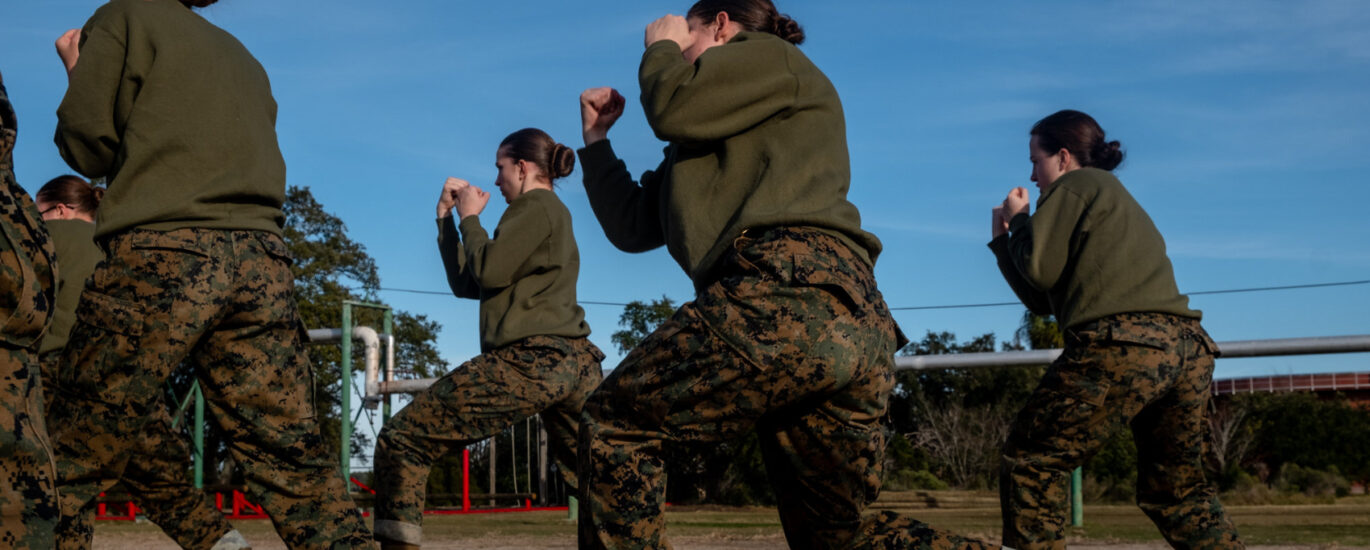
On this episode – our very first episode of Season Two – we’re joined by Abby, an active-duty marine, who takes us all on a journey into patriarchy in the military, including what women’s wear looks like for our troops, the ever-present stigma against working mothers and female leaders, gender essentialism, fanaticism, envisioning what equality among our armed forces might look like, and the incredible strength of our female marines.
Our Guest
Abby

Abby is an active-duty Marine with 10 years of service. Originally from the Midwest, she spent a majority of her youth traveling around the United States and gained an appreciation for different ways of life. Her love of language and culture was a natural fit for military service and she has enjoyed traveling around the world putting her passions to use. Outside of work, she enjoys reading non-fiction and writing.
The Essay
I am currently an active-duty Marine and have been for about a decade. The views expressed in this essay are my own and do not reflect the official policy or position of the Marine Corps, the Department of the Navy, the Department of Defense, or any other government or military organization. I love my profession and find tremendous fulfillment in the work I do. When I began, however, I was oblivious to any influence of patriarchy. I was oblivious to patriarchy not only in the military, but in my life in general. Fortunately, through the past several years I have been exposed by serendipity to women, books, and other resources that have opened my eyes to the structural gender bias of our society and, in turn, to the patriarchy within the military itself.
Let’s look at a few examples:
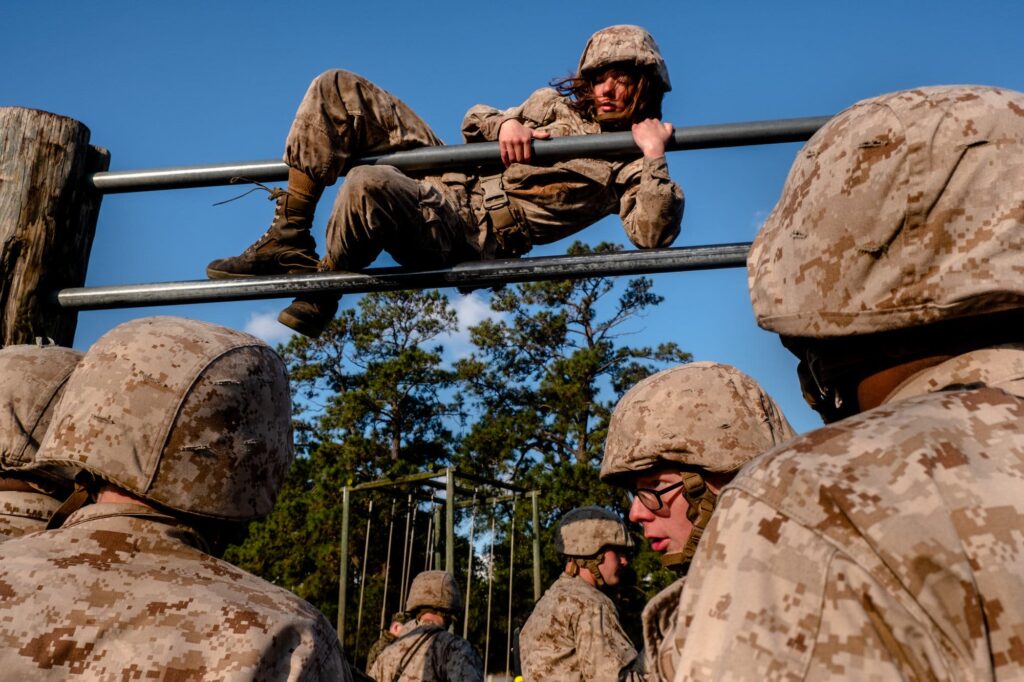
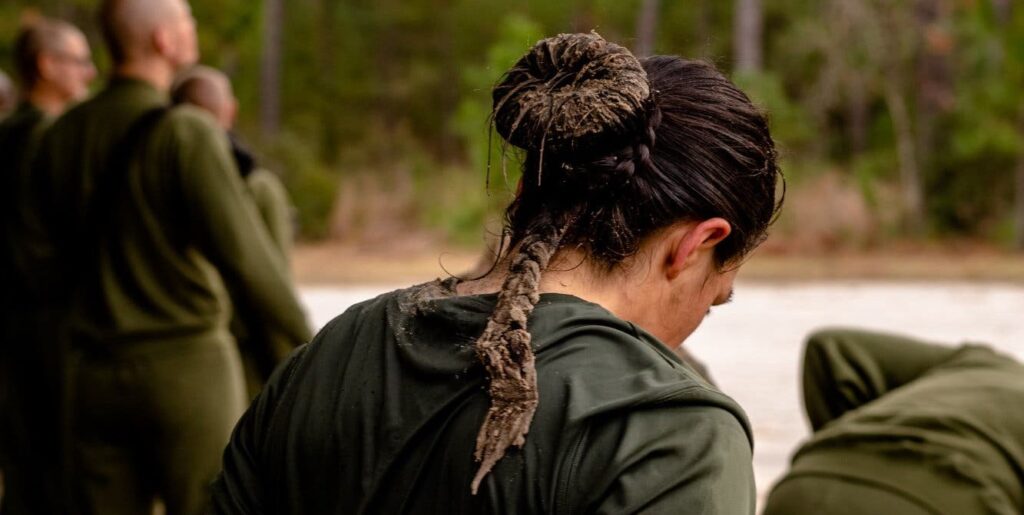
As Marines, our protective gear is designed for the so-called average body builds. But since women are a numerical minority, statistically on the lower end of the scale, and typically have larger breasts and hips, important equipment like bullet-proof vests, helmets, and gloves do not fit properly. This means the gear interferes with our ability to do our jobs well and fails to provide the protection it is designed for. Women whose hair goes below their shoulders–like myself–are required to wear it in a low bun. Helmets cannot fit over the bun, however, causing the helmet to tip forward. This prevents full coverage protection on the back and sides of the head, and also makes the helmet fall over our eyes. We also have several different packs that we carry, and they are one size fits all. They have to be so that each Marine can carry the same amount of gear and supplies, but the largest pack fits me, a 5’2” 125-pound body much different than it does my 6’2” 215-pound husband. The top of the pack comes up higher than the top of my head. Combine this with a bun roughly the size of a tennis ball on the back of my head, and I suddenly can’t hold my head up straight while wearing my equipment. If you can picture it, my military-mandated hair bun pushes my head forward as it rubs against the pack. This causes a hunched posture when carrying almost my own body weight. I feel like Quasimodo! Not to mention it limits my field of vision when I can see the ground better than the person next to me. It would seem a simple solution to just take the bun down, but no! We’re told it’s more important to follow the rules of appearance and uniformity than for our equipment to protect us and prevent further injury. And, because these issues don’t affect the majority of the force (just the majority of women), there’s “no incentive” to change the rules or change the equipment. Of course, we do always have the option of cutting our hair short…
We also have several different packs that we carry, and they are one size fits all. They have to be so that each Marine can carry the same amount of gear and supplies, but the largest pack fits me, a 5’2” 125-pound body much different than it does my 6’2” 215-pound husband. The top of the pack comes up higher than the top of my head. Combine this with a bun roughly the size of a tennis ball on the back of my head, and I suddenly can’t hold my head up straight while wearing my equipment
As of this year, women comprise roughly 9% of the Marine Corps population. This statistic is used to decide facility amenities, rather than the practicality of their use. What I mean by that is decisions are made from the mindset of “There aren’t very many of you” instead of “What do you need?” It would be like if you had 100 students in a school. Ninety speak English and ten speak Spanish. The librarian buys 50 English books and 4 Spanish books because “There aren’t very many of you.” But just because Spanish speakers are in the minority population doesn’t mean they won’t read as many books as the English speakers. The librarian decided to provide books based on population rather than practicality of use. In military facilities, women will have single-stall bathrooms and single-shower locker rooms next to men’s rooms with 3, 4, 5+ stalls and showers, despite the fact that more than one man can use a toilet at a time but only one woman can. (Yes, you heard that right. More than one man can use a toilet or urinal or port-a-john at a time. There is very little privacy in the military). And most men need about 10 seconds to wash their hair while most women need much longer. Even these smaller washrooms are an improvement over the buildings that have NO women’s rooms, though. It sounds unbelievable, but I once attended a lecture in a building I wasn’t familiar with. During a break I asked where the women’s restroom was. I was told there wasn’t one. For the duration of the lecture they cleared out one of the men’s rooms and had someone guard the door while all the women used it. We had to do this every time any woman used the bathroom during the all-day lecture. When we asked why there was no women’s restroom, the explanation given was “It’s an old building.” Somehow, this was justification for not retro-fitting one of the FOUR men’s bathrooms into a women’s room in the decades since it was built. And by “retrofitting”, I mean changing the sign on the door to read WOMEN instead of MEN. Because the bathroom itself was perfectly functional for women.
And then there’s group activities. During training events or team competitions, there’s the usual “divide the girls up equally between the teams.” I recently gave a lecture on the treatment of women in the Marine Corps and I asked the audience why they do this. Someone chimed in with total sincerity, “So no team is at an unfair disadvantage.” I looked at him and asked, “Why do you assume all women create a disadvantage?” He didn’t have an answer. But this is familiar to everyone. From school PE class to church youth group to summer camps to recreational sport leagues. Many girls know the feeling of being picked last, or not picked at all. Many times throughout my life I’ve been in a situation where captains pick their teams. They pick from the boys, and then the girls are divided up equally between the teams rather than getting picked like everyone else. The idea is that their athletic abilities or contributions will be so minimal or irrelevant that the men’s athletic abilities must be cherry picked first, because none of the other captains are going to “snatch up” a woman’s talent quickly. Or worse, the belief is that the women can just be distributed between the teams because they don’t bring any skill sets or talents at all, but a team having NO girls would put them at an advantage. So they have to be divided up once the real picking is done. I regret to report that this same grade-school discrimination is alive and well in our military today.
I regret to report that this same grade-school discrimination is alive and well in our military today.
Some people may remember several years ago when the Secretary of Defense, Ash Carter, wanted to open all combat roles to women. The military was given a deadline to make it happen by, or to provide justification for why it couldn’t or shouldn’t be done. The Marine Corps was the only branch of service to ask for an exception to the policy. The other services agreed to open all roles and the Marine Corps said no. They poured millions of dollars into studies and experiments trying to prove why it shouldn’t be done. The result were headlines that read “Mixed-gender teams come up short in Marines’ infantry experiment” and excerpts like “All-male ground combat teams outperformed their mixed-gender counterparts in nearly every capacity during a recent infantry integration test”. Congress was provided a 4-page report of the largest study and told, in summation, women couldn’t cut it. The actual report from the year-long study, however, was nearly 1,000 pages and showed a bigger picture. For example, the summary stated that women did not shoot as accurately as men during a simulated enemy engagement. That sounds like a pretty crucial fact for combat roles. But the full study shows that “not as accurately” meant a 1% difference when shooting the Individual Automatic Rifle, which is basically a machine gun that can be shot from the shoulder like a regular rifle. Or that the highest level of accuracy achieved by male Marines with any of the weapons used was 44%. Which means even the male Marines missed over half of their shots. The report to Congress also claimed that women couldn’t march as fast. It took them longer to get from point A to point B on foot. The full report shows, when conducting a 7.2 km (roughly 4 ½ mile) hike carrying the equipment of Combat Engineers (one of the combat roles being debated), all-male teams had an average pace of 5.2 km/hr. Teams with a few women had an average pace of 4.9 km/hr and teams with several women had an average pace of 4.7 km/hr. The catch? The training standard for pass/fail is 4.0 km/hr. Which means every single team performed well above standard.
If this report taught us anything, it has taught us that those with ingrained bias will go to great lengths to justify themselves. If we had extra millions to burn, we could have put it towards better equipment and training to ensure the success of all servicemembers in order to increase the overall mission readiness of the force, rather than trying to prove why women aren’t welcome.
But, of course, it doesn’t take millions of dollars or large-scale studies to let women know they aren’t welcome or taken seriously. On the day-to-day side of things, group emails are addressed to “Gentlemen”. Leaders speak to groups with lines like “Follow me, men.” Written materials use the male pronouns for Marines and female pronouns for spouses (this one has gotten a lot better, but still not great). In 2018 the Marine Corps said it would remove unnecessary pronouns from all of its manuals, textbooks, reports, etc…but this still hasn’t happened completely. I was recently completing an online class and had to laugh when I read a description of the proper form of a pushup. It read: “The Marine should lift the body using the strength of only his arms, keeping his or her body in a generally straight line.” In one sentence they managed to use a non-gendered article (“the body”) with a gendered pronoun (“his arms”) and two pronouns (“his or her body”). Wouldn’t have just been easier to say “Marines should lift their body, keeping it in a generally straight line, using only the strength of their arms”? In another personal example, I received an email addressed to all the members of a team (roughly 50 individuals) congratulating them on recent achievements. There were roughly 6 women on this team, 3 of which played a crucial role in the team’s success. The email was addressed to “Gents”. It wasn’t a matter of oversight, considering the 3 women and their contributions were referenced by name. I responded to the sender and politely explained that it would be better to use “Marines”, “Team”, or something similar on future correspondence since there were a number of women on the team and “Gents” was exclusionary. He responded to me by saying that “Gents” was in fact gender neutral because it was short for both gentlemen AND gentlewomen. I don’t know how often in your life you use “gentlewomen”, but according to the Oxford English dictionary it’s an archaic term only used today in the chambers of Congress. While these things may seem minor, they are part of the larger, continual bombardment that is happening around us every day of our lives. I choose to laugh at these events so I don’t lose my sanity entirely, and I can save my anger for the truly egregious offenses.
As I’ve become increasingly vocal about these issues, I’ve been supported by other strong women who share my experiences. I’ve also been told many times, by men and women alike, “You’re creating problems where problems don’t exist.”, “You’re ungrateful for the opportunities you have.”, “How could you say you’re oppressed in this day and age?”, “There’s no limits to women in the military.” And on and on. There are times when I start to believe them. Who am I to complain? Compared to decades past, can I really say I’m oppressed because I’m a woman?
As far as patriarchy in the military, there have been *tremendous* improvements through the last few decades. I never want to gloss over them because I am grateful to be the recipient of the rewards that other women worked very hard for, and many wonderful men supported and championed. I take every opportunity I can to thank those who have opened doors for me and fueled my success. But every time I do, I hear myself saying “I couldn’t have done it without them. They gave me opportunities I couldn’t have gotten otherwise. Their recommendation got me a seat at the table.” And I realize that, as long as I am granted “permission” by men to be equal in the military, I’ll never actually be equal at all.
…it doesn’t take millions of dollars or large-scale studies to let women know they aren’t welcome or taken seriously. On the day-to-day side of things, group emails are addressed to “Gentlemen”. Leaders speak to groups with lines like “Follow me, men.” Written materials use the male pronouns for Marines and female pronouns for spouses
When I talk to people about the progress we are making, I tell them “The hardest part of change is the first 10% and the last 10%. We are in the last 10% and it is up to us to finish the work that so many before us fought for.” To begin a change, especially one that is so internalized and institutional, it can be incredibly daunting. You are stepping out. You are going against the flow. You are presenting new ideas and concepts that no one has talked about before. It can feel like emptying the Sahara Desert with a tablespoon–will you even make a difference? But that last 10% also brings its challenges. You are tempted to be lulled into complacency. You hear the voices saying women have come so far and are equal now. What is there left to fight for? Is it worth fighting for such “little things”? You feel like you are nagging and nit-picking and being high maintenance. Rarely do we stop to think that those feelings are all evidence of the patriarchal attitudes that continue to pervade the population. Whenever I think about calling it “good enough”, I think of how disappointed my predecessors would be to see their work abandoned with a complacent shrug.
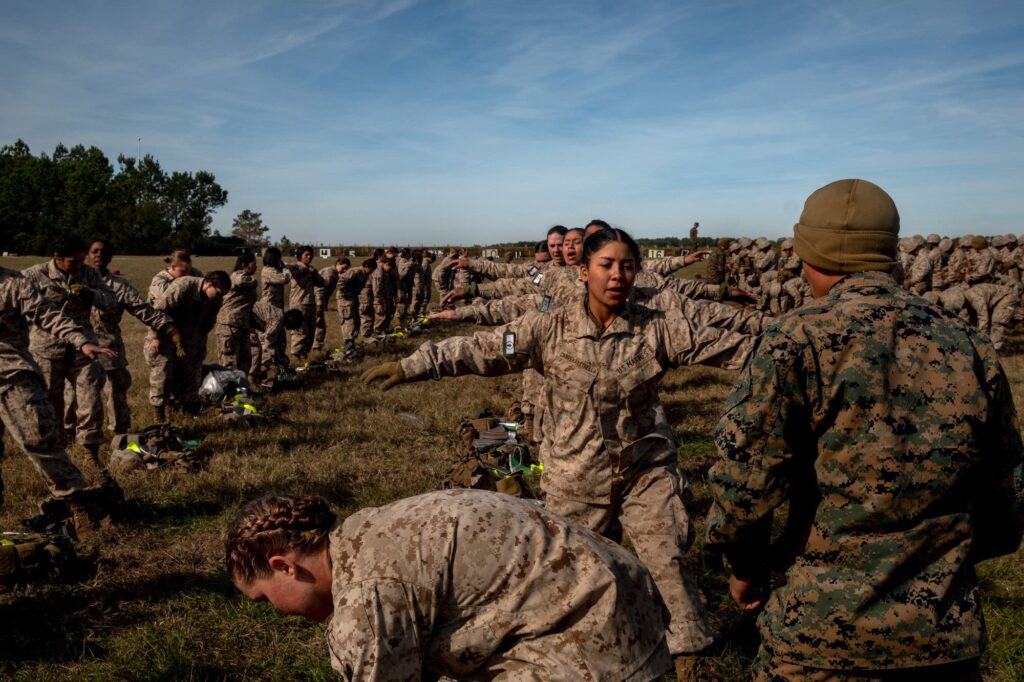
Not long ago, I had the honor of meeting Marine Corps veterans from a local American Legion when they were welcoming my detachment home from deployment. I met a woman named Mary who had served 16 years from 1971 through 1987. Her first words to me were, “I can’t believe your uniform fits!” When she was in, they didn’t make utility uniforms for women. She had to find the smallest size she could and tailor it herself. It was the same with her boots. I wear a women’s size 6, which translates into a boot size 3 because the “unisex” boots are actually just men’s. I have to special order mine and Mary is quite a bit smaller than me so she had no choice but to flop around in boots like clown shoes. She asked me how I was treated. She asked me about training. She told me about how she needed her parents’ permission to enlist at 20 years old. Today, girls only need permission if they are 17–the same as boys. She said they never gave women rifles or taught them how to shoot. Today, female recruits qualify with the same weapons on the same ranges to the same standards as their male counterparts. She was once sent out to a training exercise in the field. The men were provided tents and sleeping bags, but as the only woman she was told she needed to drive home every night and return each morning. It would have been several hours roundtrip each day. She fought to stay with her group and as a compromise she slept in a tent with guards on all four corners. Today, I train night and day alongside my fellow Marines. We work, eat, and sleep as a team. I get so disheartened sometimes when I see how much work is still left to be done in the fight for equality. But then I meet women like Mary–women who fought for their place in this “boys club”–and I see how her fight paved the way for me.
Another huge area of progress has been motherhood. This is often used as an argument for why women shouldn’t be allowed in combat roles, or even in the military at all. When I was in entry-level training, all the women in my group were taken into a classroom (while the men continued with training) and we were lectured for well over an hour on why we shouldn’t pursue demanding combat roles because it would lead to permanent damage of our bodies that could cause infertility. With each generation of military service, the same old excuses continue to surface. The clutch-my-pearls shock of “What if they get pregnant?” is not new to the combat roles debate. The Women’s Armed Services Integration Act passed in 1948 granted women the ability to serve on active duty. A report from that same year stated, “It is believed that a woman who is pregnant or a mother should not be a member of the armed forces and should devote herself to the responsibilities which she has assumed, remaining with her husband and child as a family unit.” The following year, in response to the creation of separate policies that required the discharge of any woman who became pregnant while in the service, the Chief of the Bureau of Medicine for the Navy took a stand. Expressing an extremely unpopular opinion of the time, especially for someone so high ranking within the military, he said: “Inasmuch as pregnancy is a normal biological phenomenon in women in the military age group it must be assumed that the possibility that women entering the regular military service become pregnant was recognized by Congress when the Women’s Armed Services Integration Act was enacted. It would appear to this Bureau that the apparent purpose was to afford women an opportunity to enter into and remain in the military service as a career and that the subject proposed regulation is inconsistent with this purpose… In connection with the foregoing, it cannot be presumed to be the policy of the military service to regard either the institution of marriage or the raising of a family with disfavor.”
So what if she gets pregnant? First of all, not all women want children. Some want one or two. It doesn’t matter. To deny a potential 20+ year career for something that may involve less than 10% of that time is laughable. That’s like denying someone because they could potentially break their leg. Marines strive to be “the most ready when the nation is the least ready.” Readiness is the focus. Pregnant or post-partum Marines account for 0.003–0.005% of the Marine Corps’ end strength. By contrast, far greater percentages of Marines are undeployable for injuries, long term illnesses, financial or family difficulties, legal issues, and educational or professional programs. A Task & Purpose article from 2020 stated: “…in the Army, 3000 more active duty soldiers were nondeployable due to legal reasons in 2019 than due to pregnancy. In the Marine Corps, about 700 more Marines were non-deployable due to administrative problems every month than from pregnancy.” The same article goes on to say, “There are limitations to the data. For example, it does not track whether the service members were attached to units scheduled to deploy. That means there may be service members who were able to time their pregnancies to not interfere with deployment but are still counted in the non-deployable category.”
We are long (although sadly not THAT long) past the days when pregnancy was a reason for separation. Women can and do serve long successful careers as Marines and mothers. But there is still a stigma that women in service will take advantage of the medical benefits and use back-to-back pregnancies to collect a paycheck for 4 years and then leave the service. Or use pregnancy to avoid deployment or other undesirable assignments. But according to data from the 2019 Dept of Defense Demographics Report, 2,853 servicemembers (gender not specified) left active duty for “Personal or Family” reasons. Compare that to the number who left (gender not specified) for Behavioral/Performance/Conduct issues at a whopping 43,546. An analysis of Marine Corps enlisted recruit training attrition between 2005 and 2013 found the difference in attrition between women who were married or had dependents upon entering training and those who were single was not statistically significant. Men who were married or had dependents did have slightly higher attrition than those who were single.
Pregnant or post-partum Marines account for 0.003–0.005% of the Marine Corps’ end strength. By contrast, far greater percentages of Marines are undeployable for injuries, long term illnesses, financial or family difficulties, legal issues, and educational or professional programs. A Task & Purpose article from 2020 stated: “…in the Army, 3000 more active duty soldiers were nondeployable due to legal reasons in 2019 than due to pregnancy. In the Marine Corps, about 700 more Marines were non-deployable due to administrative problems every month than from pregnancy.”
Why do we treat pregnancy different than any other medical condition? Compare pregnancy to a severe broken leg. An injured Marine will require hospitalization, several weeks of convalescence, limited work assignments, frequent doctor visits, and months of physical therapy. Full recovery follows almost the exact timeline as pregnancy. But we do not prevent Marines from driving cars, riding motorcycles, surfing, or even jumping out of airplanes. When a Marine is injured, the unit adapts and finds ways to utilize that Marine in whatever capacity they are able. The Marine is accommodated and supported. Just because pregnancy is unique to women doesn’t mean it should be stigmatized apart from any other medical condition. Along with pregnancy, women in the military get accused of sleeping around and/or getting “knocked up”. Now, I’m not going to talk about the double standards regarding sexual activity, but I shake my head when women are shunned for being pregnant as if they did it to themselves… Who do they think is doing the knocking? Again, from the 2019 DOD Demographics Report, there were over 27,000 men who became first time parents and just shy of 7,000 women. Over half of married female members in the Marine Corps and the Air Force are married to other service members. Across the DOD, it averages to 45% being in dual military marriages. There were 224,760 women on active duty in 2019, but 484,213 servicemembers have children. There were 977,191 children claimed as dependents. Clearly our male service members are not opposed to having families. And while we’re here, lets also acknowledge the 6,236 sexual assaults reported in 2019. Accounting for unreported incidents, that number is estimated to be closer to 20,500 across the DOD. While there are women who assault and men who are assaulted, the vast majority of sex crimes are perpetrated by men on women.
Ultimately, sex and pregnancy are just another way women continue to be discriminated against, discredited, and looked down upon–in or out of the military. I speak for what I know, but I’m sure many women in civilian employment share similar sentiments of feeling the pressure to choose between a child and a career, and experiencing discrimination and stigma no matter what they choose.
Unsupported by data, this perception, to quote the same Task and Purpose article from earlier, “lies in a complex web of ignorance, misogyny, and outdated policies.” Women are not the problem. I am thrilled when I hear stories of military leadership that support Marines through their desire to have a family–whether it was planned or not. They do exist. I have been blessed to have experienced it twice. But there is still a long way to go.
Ironically, for all the criticism of women regarding the claims of their inferiority, they are criticized for their achievements, too. Especially in patriarchal cultures you hear comments like, “Of course they gave it to the girl.” Or “I’d get promoted too if I had tits and a vagina.” Or the old classic, “I bet she slept with him to get that.” For every woman that’s recognized for succeeding in a male-dominated field, there’s someone crying, “Why do her genitals matter more than her qualifications?” (That’s a direct quote, by the way, in response to the first female Marine to become a pilot for the F-35B fighter jet. And her qualifications were over 300 hours of flight experience.) It’s a terrible question, but I’ll go ahead and answer it for you. For most of our country’s history we have had a misogynistic and gender essentialist structure – basically, you were either a man or a woman and expected to fill the social roles assigned to them. After the first Congress convened in 1789, women’s gender kept them from representing their state as Congresswomen for 130 years, and representing themselves at the ballot box for 132 years. A woman’s gender has been the foundational argument for why she can’t own land, have a checking account, run a business, serve on a jury, or even participate in sports. The prestigious Ivy League schools refused open admission to women for as many as 341 years on the basis that they admitted “only the best and the brightest.” Their position was proven to mean “only men” once the few women begrudgingly admitted at various points quickly outperformed the men academically. For 173 years a woman’s gender had everything to do with keeping her out of the military and up until the past couple years they keep her out of combat jobs. For almost our entire human history, men’s gender has mattered more than women’s credentials. So, to answer the question: If her gender can be used to justify discrimination, it can be used to justify recognition. Let this teach us to appreciate the abilities and achievements of everyone, regardless of their gender.
Another argument I commonly hear is that women only succeed because they are held to lower standards or less is required of them. My first question is always, “Who made the rules?” I’ll give you a hint… it wasn’t women. Mostly this is because women aren’t in leadership positions to make the rules, but that’s a whole other conversation! All women have asked for is opportunity. Not special treatment, not handouts or shortcuts. We simply want the same opportunities. It’s been proven time and time again that–given the opportunity–women will excel beyond all expectations. Several years ago I was recommended for meritorious promotion. The way this works is that several Marines are nominated and they must compete against each other for the promotion. I was nominated along with 2 male Marines. The process involved conducting a physical fitness test, being tested on military knowledge, an inspection of your uniform and personal appearance, evaluation of your conduct (like knowing when to sit vs stand or saying yes sir or no ma’am), and a review of your job performance record. I won the promotion and was thrilled my hard work had paid off. Later, I overheard someone saying that the only reason I was promoted was because women’s physical fitness standards aren’t as hard as men’s. For those who aren’t familiar, men and women perform the same test. It consists of dead-hang pullups, abdominal crunches, and a 3-mile run. The difference is in how the repetitions are scored. A perfect score is 300 points. A man who does 12 pullups will get 70 points while a woman who does the same will get 100 points. Rather than looking at the fact that they performed the same number of repetitions, critics accuse the women of having it easier. Again, I would like to point out… WE DIDN’T MAKE THE SCORE CHART. But the point is, the physical fitness test was one very small part of the process. I had outperformed my male counterparts in every other area and performed equally well in the physical test (thereby receiving a higher numerical score). And rather than being congratulated for my achievement, someone I thought was a friend discredited me to others behind my back. Receiving a promotion means stepping into higher levels of leadership with more authority and responsibility. On my very first day my ability to lead was called into question for no reason other than bias and judgement.
For 173 years a woman’s gender had everything to do with keeping her out of the military and up until the past couple years they keep her out of combat jobs. For almost our entire human history, men’s gender has mattered more than women’s credentials.
I read something years ago, and I really wish I could remember the source, that said men don’t want equality with women because they cannot envision a balance of power, only a transfer of power. They are afraid women will treat men the way men have treated women. That statement always stuck with me and I have mulled it over many times. For those in positions of influence and privilege, equality means a loss, whereas those in a position of disadvantage only have a sense of gain. Equality at its very root is an equalizing, a bringing to center, a balancing. It is no wonder we have a conflict of wills on the issue of equality. We ask ourselves how any human could possibly be against equality for all. It is crucial that we consider which side of the equation they are on and what they have to lose or gain. Many deny the existence of discrimination and say that equality already exists. They denounce things like affirmative action by claiming it gives an unfair advantage. But they also nod in agreement with the HR manager that hires one applicant over another because they can pronounce ‘Charles’ easier than ‘Chiamaka’. And after all, wasn’t it an unfair advantage that men were allowed to attend college, own property, have a credit card, and vote when women were not?
Geena Dunne, the founder of the Cova Project said, “Feminism isn’t about making women strong. Women are already strong. It’s about changing the way the world perceives that strength.” And yes, in a certain sense, if everyone is so dead-set on equality it seems ridiculous that we keep drawing attention to the “first woman” this, or “first African American” that. Wouldn’t true equality be NOT highlighting their gender or race? Shouldn’t we acknowledge the first PERSON to do something and leave it at that? Sure. We can certainly hope for that…someday.
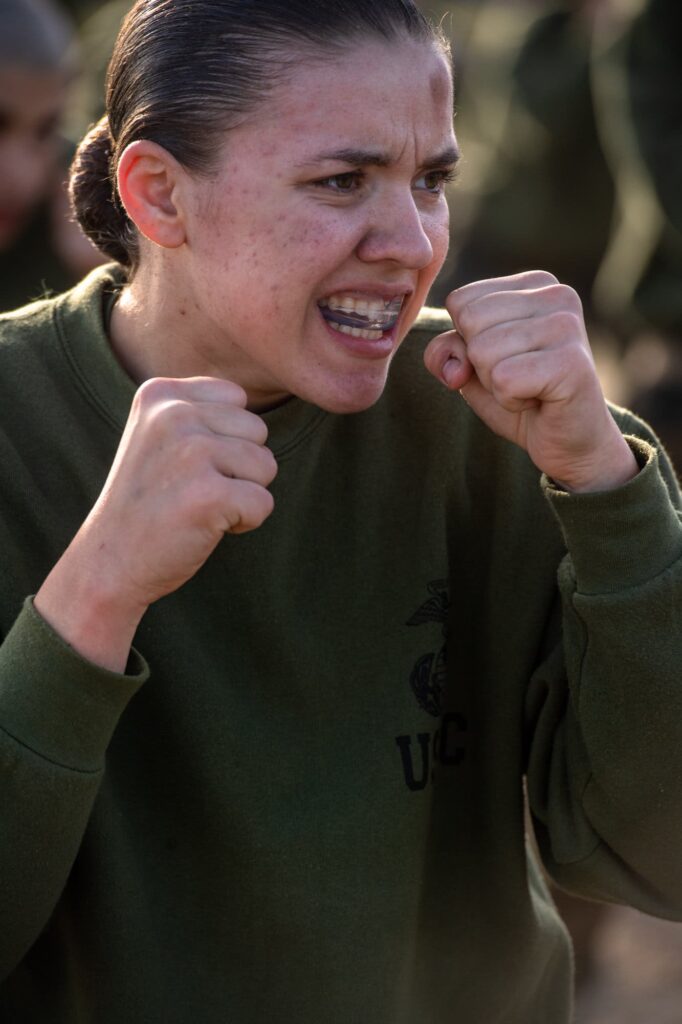
But the fact is that it’s 2022 and we are still achieving firsts in areas that were once inaccessible to whole populations of people based purely on prejudiced discrimination. To be the first of something is not about accomplishing the particular feat, but about overcoming centuries of inequality. We celebrate these firsts because they encourage us in our pursuits of a better world and remind us that we are still not done yet. We continue to celebrate firsts because when women achieve success, voices continue to roar with attitudes of sexism and discrimination. This is probably nowhere more prevalent than on social media. Posts that highlight female servicemembers are full of comments like “Females aren’t real Marines.”, “This is why we’re going to lose the next war.”, “Women are not needed and they are not wanted.”, “Vaginas get out!” and my personal favorite, “Women love special attention. Without it they become rude and crabby.”
Despite the negativity that is often rampant on social media, it has allowed me to connect with women all across the country. Once believing that I “wasn’t like most girls”, I have been lucky enough as an adult to bask in the light they shine and benefit from their courage, intelligence, motivation, and strength. I’ve come to find that ‘most girls’ are amazing women that I hope to be more like! When you’re often the only woman in the room, it’s a powerful feeling when you get the chance to be surrounded by them. I used to keep my goals to myself. You know, ‘move in silence’ and all that. Then I was introduced to an incredible group of women who said, “If you never tell anyone your goals, how can anyone help you achieve them?” I started speaking my goals and doors started opening left and right. What made the difference? I have come to believe that “move in silence” is an approach to success that supports those who benefit from the patriarchal system they’re in, whether they realize it or not. It’s easy to strive for success in silence when the system is biased towards your hiring, training, performance evaluations, promotions, and opportunities. For those who do not benefit from the system, it is more important to “move as loud as possible.” Now, this doesn’t mean screaming “Hey everyone! Look at me! Look what I’m doing!” But it does mean speaking up about an opportunity you’d like to be considered for. It means saying “I meet the qualifications for that job” when a new position opens up. It means asking for a raise when you take on more responsibility or acquire new, valuable skills. It means reaching out and saying “I’m trying to achieve this goal in the next 5 years. What would you suggest my next steps be to get there?” It means making your ideas heard so your value cannot be ignored.
10 years down the line, I am finding myself now in positions to influence the future of the Marine Corps. I have been able to advocate for the inclusion of women’s stories in military curriculum, advise on women’s maternity and postpartum needs, highlight the achievements of women within the service, provide input on the service’s advertising and recruiting campaigns to attract more women, and—most importantly—work to dismantle the patriarchal influences on the women I serve with, thereby unleashing their unfettered confidence and abilities. Nothing has given me greater satisfaction than seeing young women following in my footsteps minus the internalized impositions of gendered expectations. I’ve watched the women around me sacrifice for their goals; grow into who they wanted to become; lift heavy, run far, and encourage others to do the same; rise again and again, refusing to stay down; defy the odds and exceed expectations. They inspire me to be my best every day and strive to be better the next.
I’ve watched the women around me sacrifice for their goals; grow into who they wanted to become; lift heavy, run far, and encourage others to do the same; rise again and again, refusing to stay down; defy the odds and exceed expectations. They inspire me to be my best every day and strive to be better the next.
One of my favorite things about the Marine Corps is the friendships. Despite living in a patriarchal world and working in a male-dominated organization that supports it, I have never gone to a class, or a unit, or an event without walking away with new friends. As with every part of our lives, there are amazing people all around us. I know a lot of people are nervous about starting new jobs or moving to a new town because they aren’t sure they’ll ever make friends again. As if no other cool people in the world exist. But I am excited every time I get to be around new Marines. From job training to deployments to duty stations to professional development courses, I meet the best people that make me wonder how I ever go through life without them. There’s just something about walking into a room full of Marines, looking around, and knowing “Yep. We’re gonna have a good time here.”
An anonymous Canadian citizen is credited with saying, “Marines are about the most peculiar breed of human beings I have ever witnessed. They treat their service as if it was some kind of cult, plastering their emblem on almost everything they own, making themselves up to look like insane fanatics with haircuts to ungentlemanly lengths, worshipping their Commandant almost as if he was a god, and making weird animal noises like a band of savages.
They’ll fight like rabid dogs (the Germans nicknamed them Devil Dogs) at the drop of a hat just for the sake of a little action, and are the cockiest SOBs I have ever known. Most have the foulest mouths and drink well beyond man’s normal limits, but their high spirits and sense of brotherhood set them apart and, generally speaking, of the United States Marines I’ve come in contact with, are the most professional soldiers and the finest men I have had the pleasure to meet.”
Marines are just a little bit crazy. We tend to take things to extremes and do things just a little differently than everyone else. The military as a whole is a man’s world within a man’s world and as the saying goes, “it’s a slow turning ship.” But I am doing my best every day to make the world a better place for everyone. I work to identify unconscious bias and provide solutions to problematic policies and behaviors. Many are resistant to change, but that’s not unique. Humans in general are resistant to change. It doesn’t mean we can’t continue to push forward.
When you’re overcome by how far you have to go, just remember how far you’ve come.
Listen to the Episode
&
Share your Comments with us below!


